Most workshops buy a bench the way they buy shelving: pick the size that fits the wall, check the price, order it. Then the vice tears out of the top in the second year, or the frame racks when someone planes a long board on it, and the bench gets replaced rather than repaired.
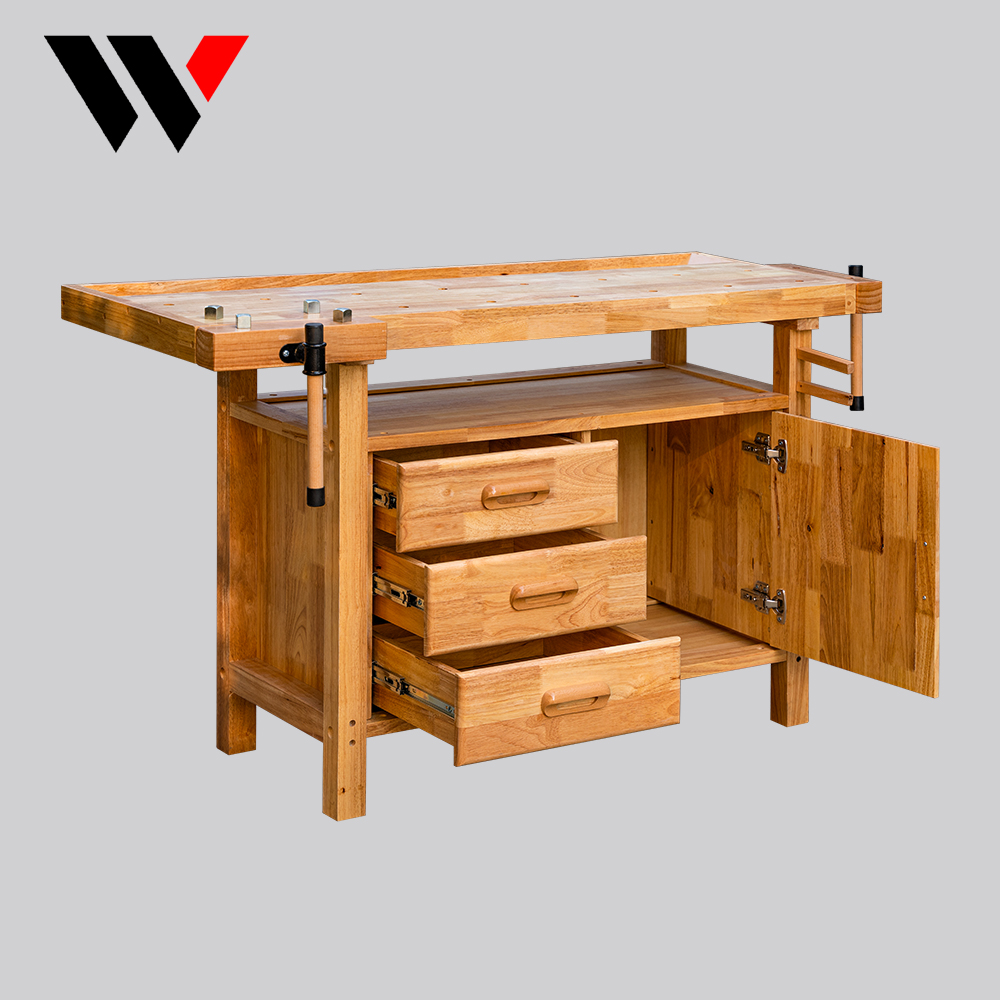
The WT01 is a working bench with numbers attached, and the numbers are small enough to check in a minute: a 1260 by 500 mm top, 16 to 18 mm thick, 50 by 50 mm legs, an overall size of 1380 by 620 by 840 mm, and 50 kg. The material is rubber or beech. It comes with vices and bench stops.
That is the entire specification, and it is enough to decide whether the bench suits joinery, a school workshop, a repair bay or a laboratory.
Twelve hundred and sixty millimetres is a door stile plus a bit. It is not a door. Anyone who has tried to hang a 2000 mm door on a bench of this length knows the problem: the panel overhangs, the bench tips forward, and the part you are working on is no longer supported where you need it.
Five hundred millimetres of depth is comfortable for a single component and cramped for two. A bench of this depth holds a vice along one edge and still leaves room to lay out a rail, a stile and a set of cutters without them falling off.
Eight hundred and forty millimetres of working height is the standard joinery figure. It suits a standing operator of average height working with hand tools. It is too low for precision assembly under a magnifier and too high for heavy chopping, which is why the same manufacturer builds the WT06 at a much smaller size.
The top thickness is published as a range, 16 to 18 mm, and the range matters more than either figure.
A 16 mm top is a light bench. It will take a vice, a bench stop and hand work. It will not take a hammer blow over the leg without flexing, and it will not hold a heavy vice bolt if the top is drilled close to the edge. An 18 mm top is a third stronger in bending for the same material, which is the difference between a bench that shrugs off a mallet and one that gradually dishes around the vice.
If the bench is for assembly and light repair, specify the lower end and save the weight. If it is for joinery with a vice and a mallet, ask for 18 mm and check that the vice bolts pass through the top and into the frame rather than into the top alone.
Thickness is also the wear allowance. A bench top is a consumable surface: it gets cut, drilled, chiselled and stained. Eighteen millimetres gives you more resurfacing life before the bench is finished.
The page offers two top materials and does not rank them, because the correct answer depends on what lands on the bench.
Beech is the traditional joinery surface. It is hard, it takes a mallet blow without denting deeply, it holds a bench dog, and it can be planed flat when it dishes. It is also heavy and it moves with humidity, so a beech top needs to be fixed in a way that lets it expand.
Rubber is the assembly and electronics surface. It grips a workpiece, it does not mark a finished panel, it damps vibration, and it is quiet. It is not a chopping surface: a chisel that slips will cut it, and a mallet will leave a permanent mark. It also has to be checked for oil and solvent resistance if the bench sits in a repair bay.
A sensible split for a mixed workshop is beech at the vice end and rubber over the assembly area, and that is a two-bench decision rather than a one-bench decision.
The legs are 50 by 50 mm, and the whole bench weighs 50 kg. Those two figures together describe a bench that is stable in use and movable when empty.
Fifty kilograms is light for a joinery bench. It is heavy enough to stay put under hand planing, and light enough for two people to shift when the layout changes, which is the reason schools and laboratories buy this type rather than a bolted-down bench.
The limit is lateral load. A 50 kg bench with a 50 by 50 mm leg section will rack if you push a long board sideways against the vice. If the work involves planning long stock by hand, either ballast the bench, fix it to the wall, or accept that the bench is an assembly station and do the planing on a machine.
That is not a criticism of the bench. It is the honest boundary of a 50 kg frame, and knowing it before purchase is cheaper than discovering it after.
The bench is supplied with high-quality vices and bench stops. That sentence is doing more work than it appears to, because a bench without them is a table.
A vice converts hand pressure into clamping force along one axis, and its mounting decides whether the bench survives. Two rules: mount the vice so its rear jaw is flush with, or slightly proud of, the bench edge, and bolt through the top into a reinforcing block underneath. A vice bolted to an 16 mm top with four short screws will pull out the first time someone tightens it on a hardwood block.
Bench stops are the other half. A stop at the far end of the bench lets you plane a board against a fixed resistance instead of chasing it. Two stops, one at each end, let you work from either side, which is what makes a 1260 mm bench usable by two people.
Check that the stops sit below the surface when retracted. A stop that stands proud when not in use will catch every panel you slide across the bench.
The same page lists a second model, the WT06, with a 430 by 280 mm top, 23 to 25 mm thick, an overall size of 530 by 280 by 70 mm and a weight of 7 kg.
That is not a smaller joinery bench, it is a different object: a bench-top platform for repair work, watchmaking, electronics and laboratory use. At 7 kg it can be lifted onto a table by one person, and at 23 to 25 mm the top is proportionally much thicker than the WT01, because a small bench takes concentrated point loads rather than spread ones.
If your work is a mobile phone, a movement or a circuit board, the WT06 is the right size. If your work is a door frame, it is not, and no accessory fixes that.
The page names the audience directly: professional joiners, joinery workshop carvers, DIY enthusiasts, schools, machinery repair shops and home use.
Those are four quite different buyers and the bench suits them for different reasons. A joinery shop buys it as a second bench beside the machine, for fitting and adjustment. A school buys it because 50 kg can be moved and because a rubber top survives a class. A repair shop buys it because the vice and the flat top are what a teardown needs. A home user buys it because it is the size of a wall.
What none of them should expect is a replacement for a 200 kg torsion-box bench in a production joinery. The product is honest about its weight and its top thickness; the mistake is in the expectation, not in the specification.
The carton is listed in two parts: 1310 by 540 by 105 mm and 835 by 535 by 210 mm. Two cartons rather than one tells you the bench ships knocked down, with the top in one box and the frame in the other, which is how a 50 kg bench stays inside parcel handling limits.
Knocked-down shipping has one consequence worth planning for: assembly quality becomes your responsibility. A bench assembled with the legs out of square will rock, and a rocking bench transfers every cut into the workpiece as a vibration. Assemble it on a flat floor, check the diagonals before final tightening, and re-check after a week of use.
For a school or a lab buying several, assemble one and use it as the reference for the rest. Ten benches assembled by eye will be ten different benches.
A bench is not a machine and it does not sit in the production sequence. It sits beside it, at the point where a part leaves a machine and needs to be checked, fitted or adjusted.
In a panel shop that point is after edge banding and before assembly, where a door needs its hinges offered up. In a solid-timber shop it is after the planing and moulding stage, where a rail needs its profile checked against a sample. In a repair bay it is the whole workflow.
Wherever it sits, the bench needs light above it and clear floor around it. A bench pushed into a corner is a shelf with a vice on it.
Two services usually land at the bench rather than at the machine. Compressed air for a blow gun and a nailer comes off the 7.5 kW piston compressor on its 230 L receiver, and extraction for hand sanding comes off a bag type dust collector. Both need a route to the bench that does not cross a walkway.
Four questions, all answerable from the specification, none of them about price.
Is the top 16 or 18 mm on the version you are buying, and does the vice bolt through into a reinforcing block. Is the top rubber or beech, and if rubber, what it resists. Are the bench stops retractable below the surface. And is the height of 840 mm right for the people who will use it, because a bench that is 60 mm too low costs more in backs than it saves in purchase price.
The bench is listed on the WT01 wooden workbench page, alongside the WT06, and it sits in the workshop equipment range with the dust collectors and compressors that a bench bay also needs. The door frame assembly machine note shows what happens when a frame is too big for a bench vice: the work moves from the bench to a machine with twenty cylinders.
If you are fitting out a workshop rather than buying one bench, send the layout and the number of stations. The bench specification is fixed; the quantity and the height are not.