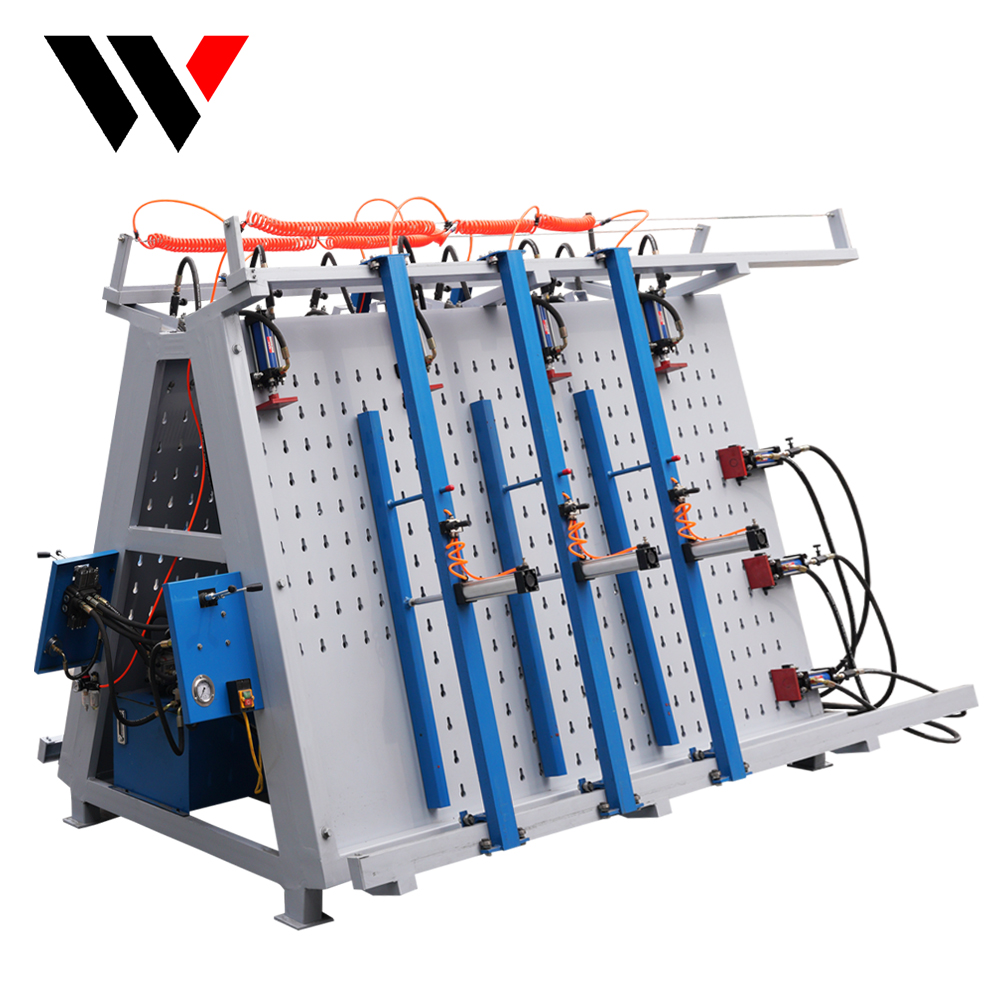
A door frame is a square. That sounds trivial until the frame is 2.4 metres tall, the stiles are hardwood, and the adhesive has to cure while all four corners stay at exactly 90 degrees. Two clamps and a tape measure will not do it.
The MK2513D is built for that single job. It holds the components square, presses the joints closed, and keeps pressure on until the glue has gone off. Everything about the machine follows from those three requirements.
The clamping layout is the machine. Three hydraulic cylinders work each side, three work the front, and four work from above, and each of those groups is doubled because the frame is clamped from both faces. Twenty cylinders in total.
Three directions is not padding. A mitre or a dowelled butt joint opens in whichever plane is left unsupported, so a table that only squeezes from the sides will let the head lift at the same moment it closes the shoulder. Pressure on the face stops that. Pressure from above stops the frame climbing as the side clamps come in.
Every one of them is rated at 4 tonnes. That is not a typo, and it is the number most buyers misread.
All twenty cylinders share the same size: 40 mm bore, 100 mm stroke. The bore sets the force. The stroke sets how far the clamp can travel, and 100 mm is a short throw.
Read that honestly. This is not a press that closes a wide gap. Components arrive roughly in position, the clamp takes up the last hundred millimetres, and the joint closes. A frame loaded out of square by more than that will not be pulled straight by the cylinders.
Which is fine, because squaring is the operator's job. The machine holds the square. It does not create it.

Maximum working size is 2500 × 1300 mm. A standard interior door frame sits comfortably inside that. So does a double frame split into two operations, and so does most window casement work.
Frame construction decides how the table gets used. Dowelled and biscuited frames close with a short stroke and want even pressure. Screwed frames need almost none. Casing added on site changes the size of the assembly entirely, which is why the casing question comes before the machine question. What does not fit is a 2.4 metre frame plus its casing assembled in one pass. Measure the largest single assembly you actually build, then add the clamp bars, because the bars occupy part of that 2500 mm too.
There is one test that matters on a door frame and it costs nothing to run. Measure both diagonals. If they are equal, the frame is square. If they are not, the difference tells you how far out it is and which corner is pulling.
A framing square is worse than useless at this size. It reads the corner, not the frame, and a 2.4 metre assembly can have four perfect corners and still be a rhombus.
So the machine exists to hold what the tape measure just proved. Clamp. Measure. Adjust. Measure again. Once both diagonals agree, leave it alone until the glue has gone off, and resist the urge to check it a third time.
A softwood jamb is maybe 35 mm thick. Four tonnes applied to a pad on that face will crush the fibre long before it helps the joint, and the damage shows up as a dent under the paint, months later, at the customer's site.
So the pressure regulator is not a detail. Set it for the species, not for the maximum, and set it once with a sample joint in the machine rather than on the first paid order.
Clamping time is the other half of the same decision. A PVAc assembly glue wants pressure until the joint has taken up, then it wants to be left alone. A PU needs moisture and a longer hold. Epoxy does not care about much except being undisturbed. The machine is indifferent to all three, which means the schedule has to be written by whoever specified the adhesive.
The blue clamp bars ride on a perforated panel, which is what makes the machine flexible. Bars move to suit the frame, and the hole pattern gives them positions that repeat from job to job.
Repeatability matters more than flexibility here. A frame that comes off the table square builds the same way every time, and a setting that lives in a hole rather than in somebody's memory is a setting that survives a shift change.
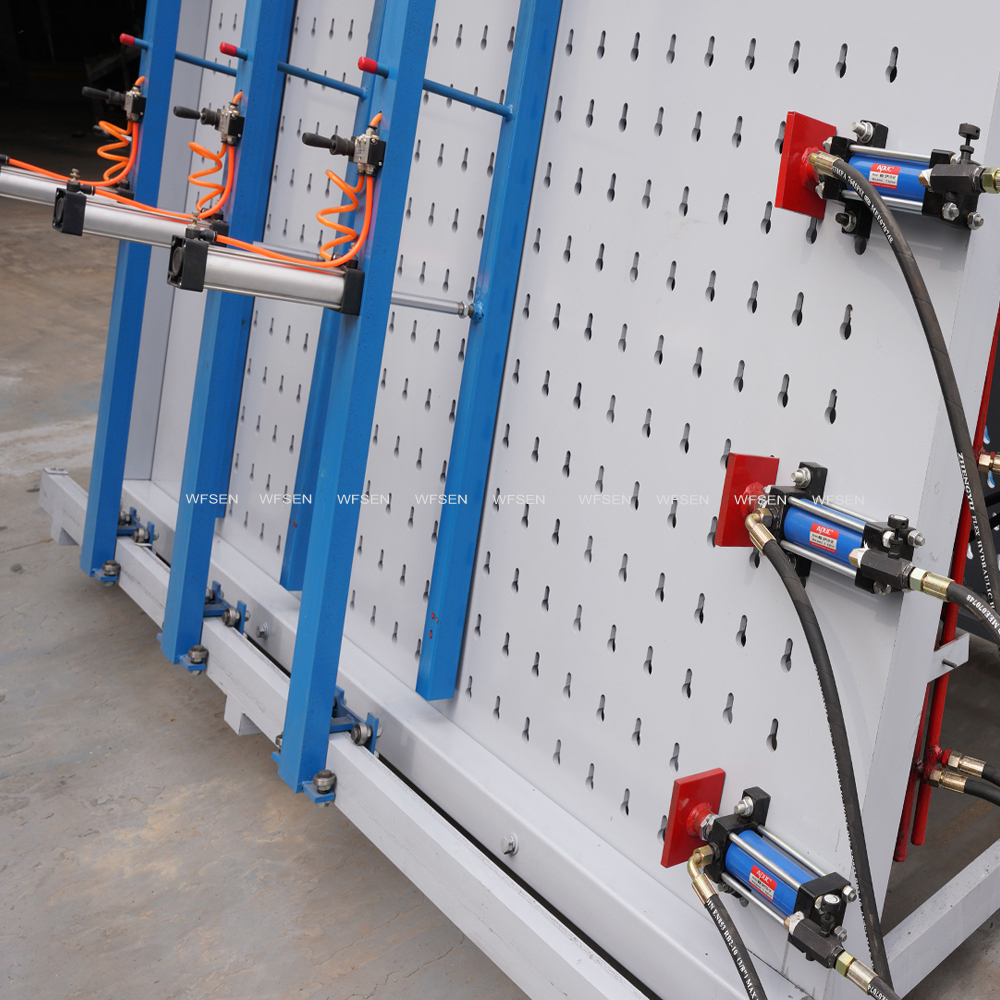
The hydraulic power pack runs on a 2.2 kW motor. Small, for twenty cylinders, and that tells you the machine moves slowly and deliberately rather than fast. Clamping is not a race.
Oil rather than air is the right choice here, and not because oil is stronger, but because oil is incompressible and a joint that relaxes while the adhesive cures never fully recovers. Air is compressible: a pneumatic clamp that holds 4 tonnes at nine in the morning will hold less at four in the afternoon if the line pressure sags, and a joint that relaxes under a curing adhesive does not fully recover. Oil does not sag. It holds what it was set to hold.
Working air is 0.6 MPa, the same figure that appears on almost every machine on this site. If the shop already runs a compressor at that pressure, this machine needs nothing new.
The machine weighs 1,200 kg and stands 2,200 mm tall, which is a big flat object rather than a heavy one. That is good news for the floor and bad news for anyone planning to walk around it in a narrow bay.
Access on the loading side is the constraint. You need room to carry a 2.4 metre frame in and out, and that space is never on the drawing.
Getting the machine into the building is a separate project from using it. It arrives as one welded structure, it clears a doorway only if that doorway has 2,200 mm of height, and the bay has to be empty before it lands because there is nowhere to put it down twice.

It does not cut. It does not drill. It does not sand, and it does not press a veneered skin onto a door blank. There is no hinge pocket in this machine and no lock bore.
Those operations belong to other equipment. Hinge boring and lock mortising are covered in this look at drilling machines for panel furniture, and the MXZ4028 lock mortiser handles the lock side on its own.
Skins are a membrane press job. Nothing on this table will do it.
Not in speed. In scrap. A frame assembled out of square is discovered at hanging, which is the most expensive possible moment, and by then the door blank has been drilled to match it.
One saved frame a week pays for the clamping time. Boring work. Expensive mistakes. The machine is deliberately the dullest thing in the shop, and that is the point.
Three faults show up on frames and none of them come from the machine. A starved joint, where the glue was spread thin and the clamp closed the gap anyway. A twisted jamb, which was twisted before it went in. And spring-back, where the frame was released too early and moved a millimetre overnight.
Measure the largest frame you build, including casing. Check the species you clamp and think about what 4 tonnes does to it. Confirm the air supply and the 2.2 kW circuit. Walk the floor and see whether a 2.4 metre frame can actually turn in the space.
Four things worth asking a supplier that no brochure answers. Whether the clamp bars can be repositioned to a custom pattern. Whether pressure is regulated per zone or for the whole table at once. Whether the machine ships assembled, because 3800 mm does not fit in a 20 foot container standing up. And who supplies the first set of pressure pads, because those get replaced more often than anything else on the machine.
Then look at the MK2513D page for the full table, and at the rest of the supporting equipment range if the frame is only one step in a door line.