A slicer delivers veneer in leaves, not in sheets. Each leaf is a few tenths of a millimetre thick and a couple of hundred millimetres wide, and a press cannot use it until somebody turns those leaves into one continuous piece. That is the whole job of a splicing machine.
The LS1800 does it with glue thread instead of tape. The difference sounds cosmetic. It is not, and anyone who has spent a shift sanding zigzag tape off a face knows exactly why.
Paper tape came first. It still is, in shops that never changed. A stitcher lays a zigzag of gummed tape across the seam, the joint holds, and the tape then has to come off again before finishing. Somebody has to do that, and on a thin face the sanding that removes the tape also removes veneer.
Glue thread is the second route. A fine filament of hot melt is fed into the seam and melted in place, so the bond sits inside the joint rather than on top of it. There is nothing to remove afterwards.
The third route is edge gluing with a separate machine and a separate cure. It works. It is also a second machine, a second operator pass, and a second chance to introduce a gap.
A roll of tape costs almost nothing. The hour a day spent taking it off again costs more than the difference between the two machines, and that arithmetic is what moved most plywood lines onto thread in the first place.
Because the seam leaves the machine finished. Simple as that. No tape, no second pass, no operator judgement about how hard to sand. Stack the spliced veneer, let it cool, and it goes to the press.
The joint is also thinner than a taped one. On a 0.6 mm face that difference is visible under a finish, and the customer who opens the container is the one who notices.
There is a handling difference too. A taped stack has to be carried flat and kept flat, because the tape is on the outside and it lifts at the corners. A thread-spliced stack behaves like veneer again within seconds of the head passing over it.
Two leaves joined along their edges can be flipped or not flipped, and the choice changes the face of the finished panel. Book matching mirrors the two leaves against the seam. Slip matching turns both the same way, so the grain repeats instead of mirroring.
Neither is more correct. Book match is the default in most furniture work because the pair reads as one piece. Slip match looks calmer on species with heavy figure, where a mirror image becomes a distraction.
What matters at the machine is that the order survives the splice. Once a seam is glued, the sequence is locked, and a bundle spliced out of order cannot be fixed downstream by anybody. Mark the leaves before they reach the head, not after.
Minimum splicing length is 300 mm. Below that the machine has nothing to grip long enough to hold register, and the seam wanders. This is the number that decides whether oddments from the clipper are usable or scrap.
It matters more than it looks. A plywood line generates short pieces all day, and a machine that can only handle long leaves turns them into waste. Three hundred millimetres is short enough to rescue most of them. Most, not all.
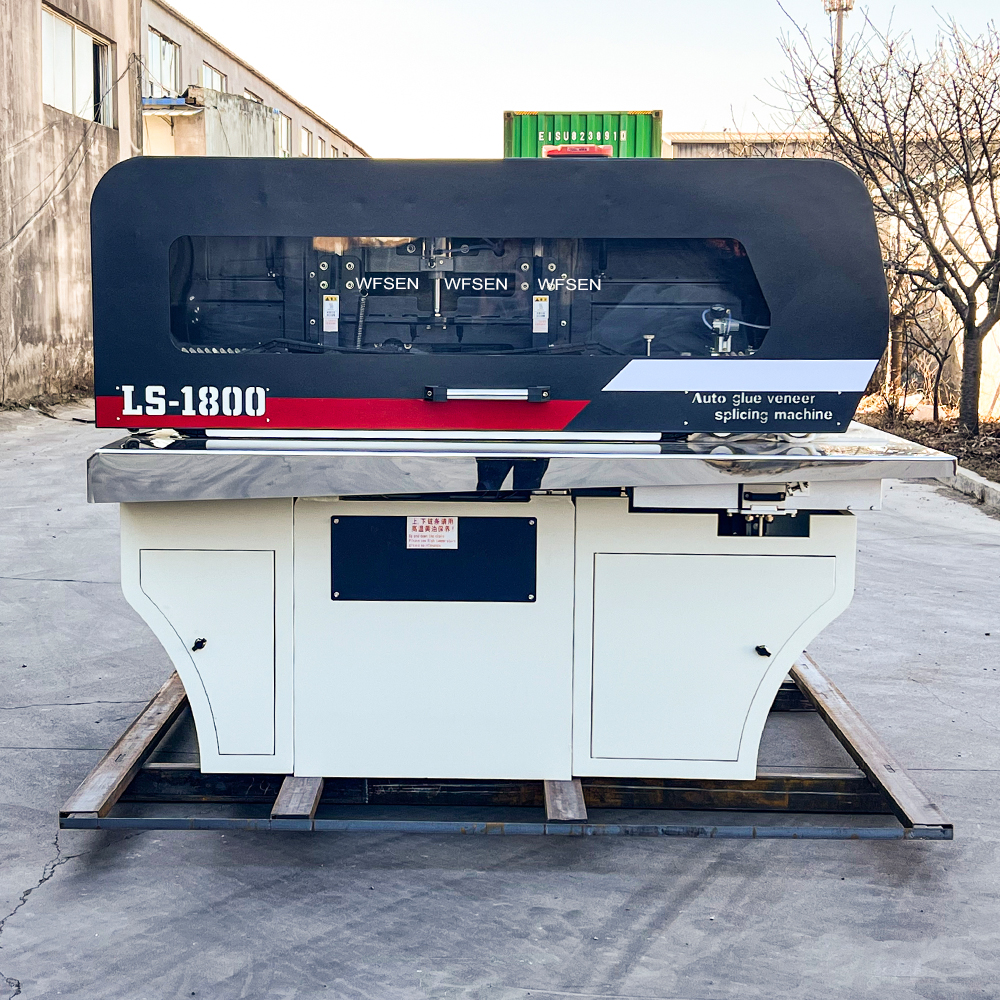
Splicing width runs from 40 mm to 1600 mm. Forty millimetres is a strip, not a leaf. Narrow, but real. Being able to feed one is the difference between recovering a bundle of offcuts and selling them as fuel.
Working table height is 920 mm. That figure never appears in a sales conversation and it should, because the operator stands at this machine for a whole shift, feeding thin material by hand, and a table fifty millimetres too low is a complaint by Thursday.
The splicing temperature window is 100–220 °C, and that range is wider than it needs to be for any single thread. It exists because the thread has to match the veneer and the room.
Run too cold and the bond fails a week later, in a stack, in a container. Run too hot and the thread chars, the seam darkens, and a pale face shows every joint. Set it by the thread, not by feel. The correct figure is a specification question, not a preference.
Room temperature matters as much as the dial does. A machine tuned in summer can behave differently in January, because cold veneer pulls heat out of the seam faster than warm veneer does, and the thread has less time to wet the edge before the pressure comes off.
Splicing thickness is 0.3–2 mm. At the thick end this is a forgiving machine. At 0.3 mm the veneer is closer to paper than to timber. Thin veneer forgives nothing, so everything about the feed has to be gentle: no snatch, no drag, no sudden tension.
Anyone buying for a 0.3 mm face should ask what the minimum thickness on the spec sheet means in practice, and should expect to tune the machine on their own material before it earns its keep.
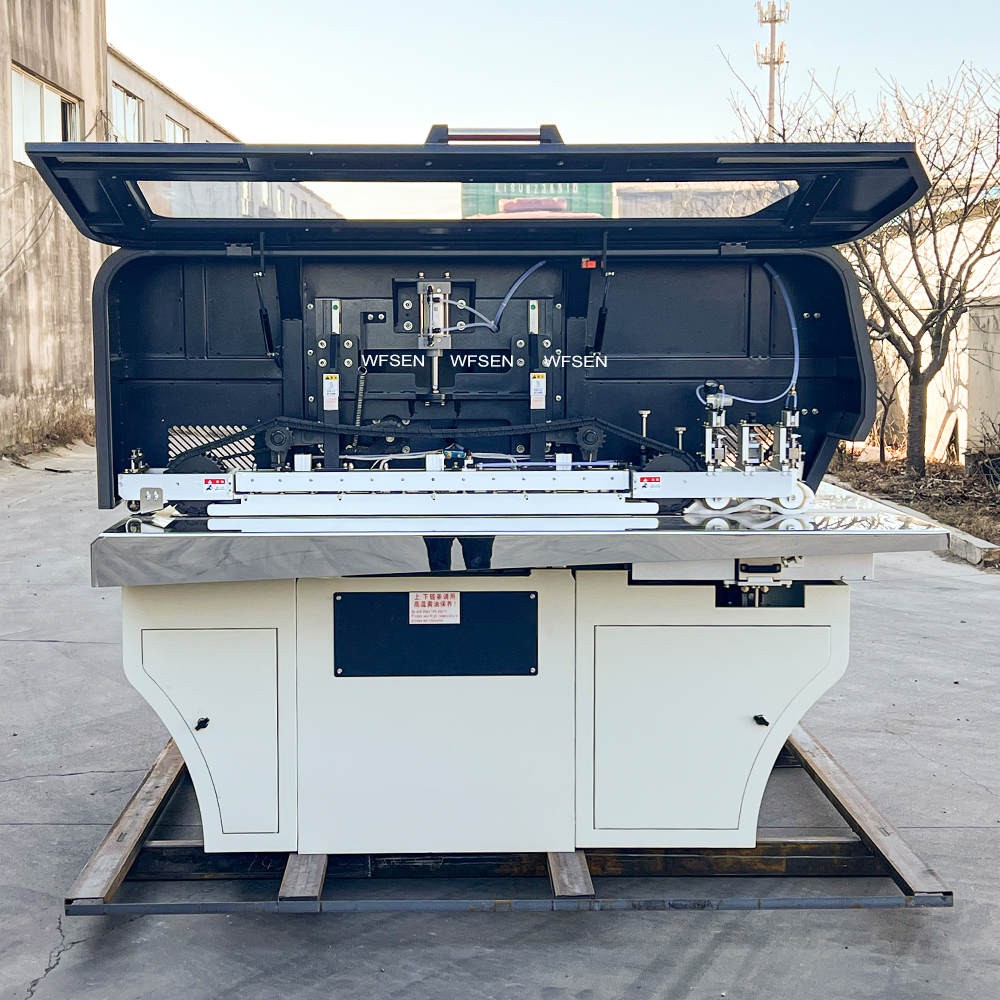
Total power is 8 kW. Two jobs, one supply: heating the thread and driving the feed. The heat is the part that cycles. The drive is the part that runs constantly.
The machine measures 2100 × 2100 × 1700 mm, which is a square footprint. That catches people out in a tight veneer room, because the machine is as deep as it is wide and the operator needs access on both sides.
The sequence is fixed. A veneer clipper squares the leaf and trims the defect. The stitcher joins what the clipper produced. The pressing line then takes a full sheet.
The nozzle is the part that fails first. Thread residue builds on the tip, the seam starts showing a dry patch, and the operator notices three panels later. A wipe at every shift change costs less than the veneer that gets pressed before anybody spots it. Get the order wrong and the line stalls. A stitcher with no clipper in front of it is fed by hand and runs at a fraction of its capability, and a clipper producing leaves nobody can join is just making expensive scrap quickly.
Throughput is set by the operator, not by the head. The head moves faster than hands can place leaves, so the real limit is how quickly two edges can be lined up and released. Two people on one machine beat one person on a faster machine, and no specification sheet will ever say so.
It will not flatten a buckled leaf, it will not match colour or grain, and it will not turn a bundle of mismatched offcuts into a face anybody would pay for. It will not close a gap the clipper left, because the thread fills a seam and not a hole, and a wide joint stays a wide joint whatever runs across it.
Bad veneer still looks like bad veneer after splicing. The machine protects a good joint.
And it cannot make a joint strong enough to handle as a sheet on its own. Spliced veneer is a handling aid, not a structural material. Lift it by the edge with two hands, or it will find the weakest seam and open it.

Veneer thickness across the range you actually buy, not the sample. The narrowest strip the clipper produces, because 40 mm is a capability and 45 mm is a habit. The shortest joint your product allows. The thread specification and its melting window. And the room you have for a 2100 mm square.
| Item | LS1800 |
|---|---|
| Min. splicing length | 300 mm |
| Splicing width | 40–1600 mm |
| Splicing thickness | 0.3–2 mm |
| Splicing temperature | 100–220 °C |
| Working table height | 920 mm |
| Total power | 8 kW |
| Overall dimension | 2100 × 2100 × 1700 mm |
Those five decide the purchase. The LS1800 page carries the full table, the MQ320 clipper is the machine upstream of it, and the whole sequence sits inside the plywood production line.