A sanding belt is the only part of a wide belt sander that wears out on a clock you control. Belts get replaced, boards get fed, grit gets changed. Everything around the belt — the frame, the rollers, the conveyor — is meant to outlast a decade of that.
That is why belt sizing starts from an odd place. The first two numbers you need are not about abrasives at all. They are the length and width of the loop your machine was built to tension, and they are already written on the machine's specification sheet. Order by grit alone and you will end up with the right grain on a loop that will not fit.
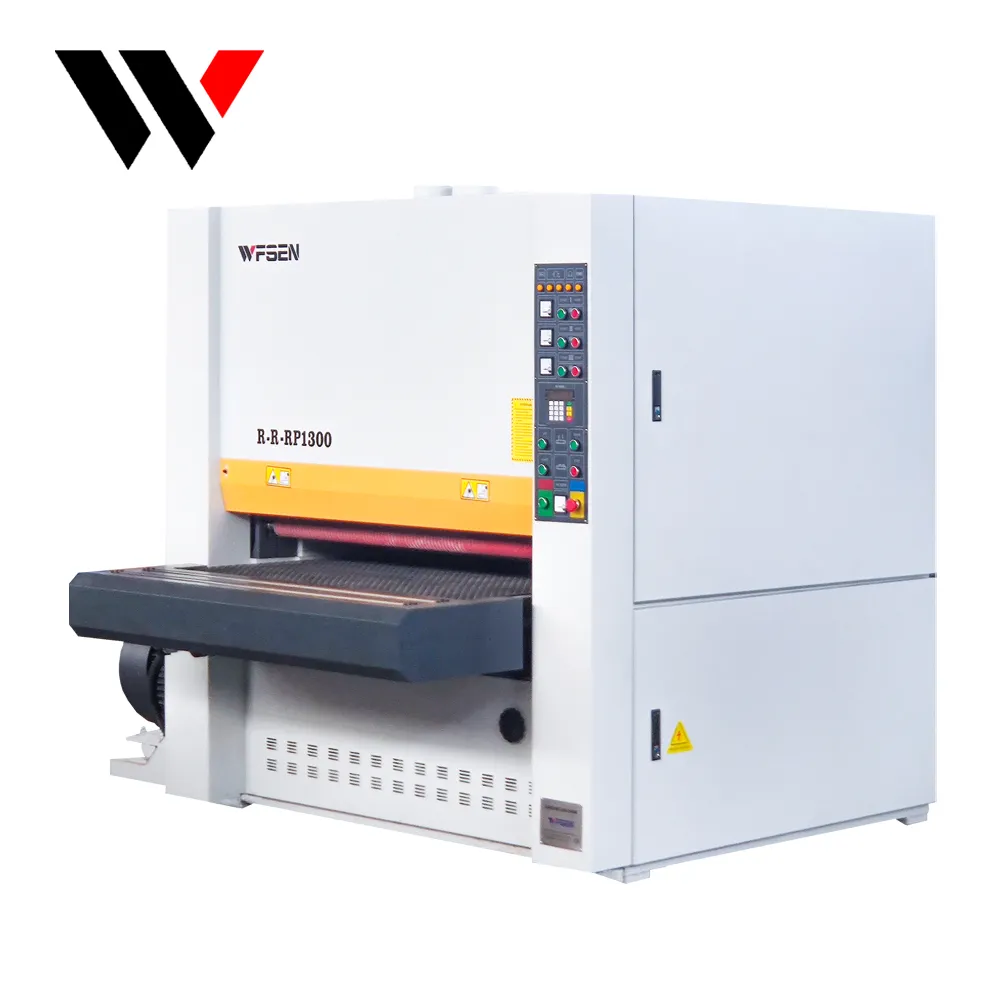
Take our R-R-RP1300 wide belt sander. Its specification table lists the abrasive belt size as 1020 × 2020 mm for the 1000 mm machine and 1320 × 2020 mm for the 1300 mm one. Two belts, two working widths, one published field.
Read those against the working width and a pattern appears. 1020 against a 1000 mm machine. 1320 against a 1300 mm machine. The belt runs 20 mm wider than the surface it sands, on both sizes. That extra width is not a mistake in the table — a belt has to be wider than the part if the edges of a board are to be sanded flat rather than rounded off by the belt's edge.
So the width is a machine property. It does not change when you move from a coarse belt to a fine one, and it does not change when you switch from veneered MDF to solid oak.
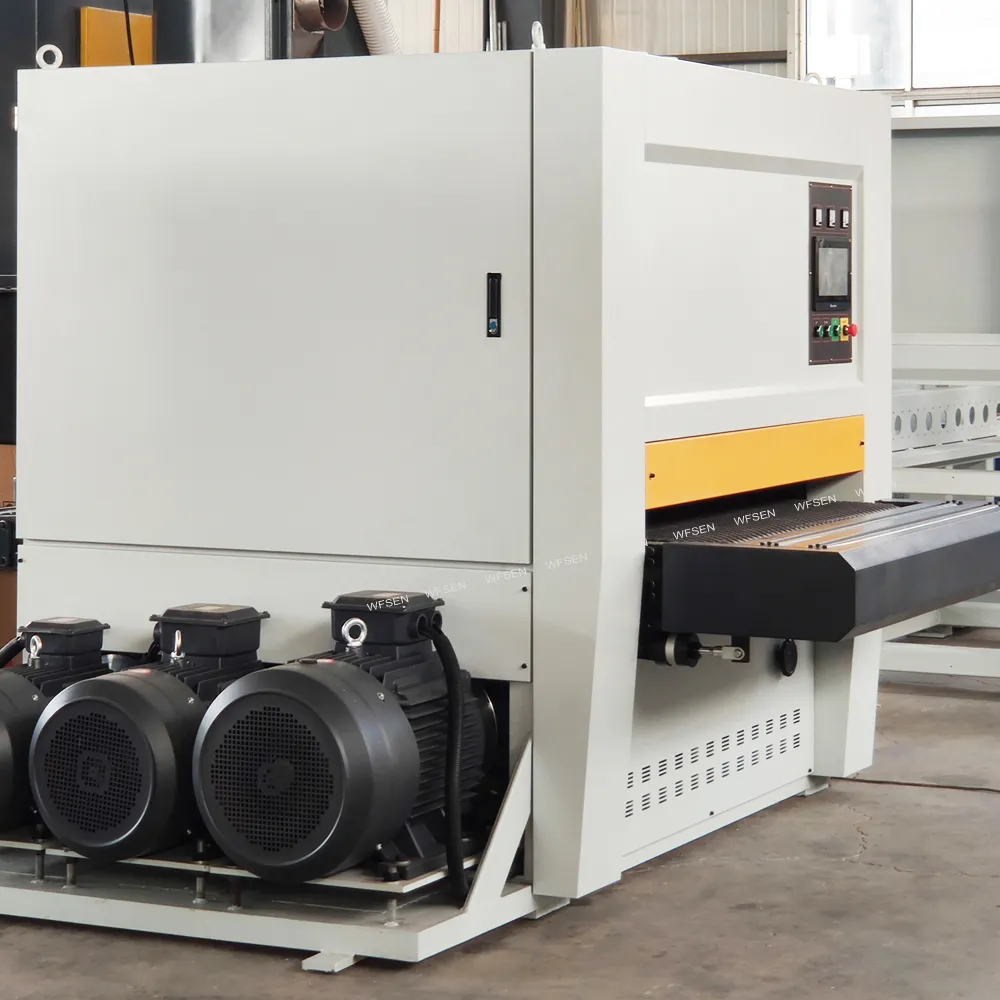
Five of our sanding machines publish an abrasive belt size. Here they are, taken from each machine's own specification table.
| Machine | Working width | Published belt size |
|---|---|---|
| R-R-RP1300 wide belt sander | 1000 / 1300 mm | 1020 × 2020 / 1320 × 2020 mm |
| B-R-RP1000/1300 planer sander | 1000 / 1300 mm | 1020 × 2020 / 1320 × 2220 mm |
| R-R1000/1300 primer sander | 1000 / 1300 mm | 1020 × 2020 / 1320 × 2220 mm |
| MM2617 vertical belt edge sander | 170 mm sanding height | 3120 × 170 mm |
| UR- / DR-R-RP1300 top and bottom line | 1300 mm | not published |
One row of that table reads "not published", and it is the two-machine line that most needs the answer. We say so rather than fill the gap with a guess. Belt size for the top and bottom sanding line has to come from us in writing, because there are two machines in the line and the answer covers both.
This is the part that catches buyers out. Look down the 1300 mm column and the belt lengths are not the same. The wide belt sander takes a 2020 mm loop. The planer sander and the primer sander both take 2220 mm.
Two hundred millimetres. That is the whole difference, and it is enough to make a belt useless on the wrong machine. A 2020 mm loop will not reach around a roller set spaced for 2220 mm. A 2220 mm loop on a 2020 mm machine will not tension — the take-up runs out of travel and the belt slips the moment it takes a cut.
Length follows the roller layout, not the width class. The planer sander carries a planing head in front of its sanding heads, which pushes the roller centres apart. Same 1300 mm of sanding width, longer frame, longer belt. Nothing in the model name tells you which of the two you are buying.
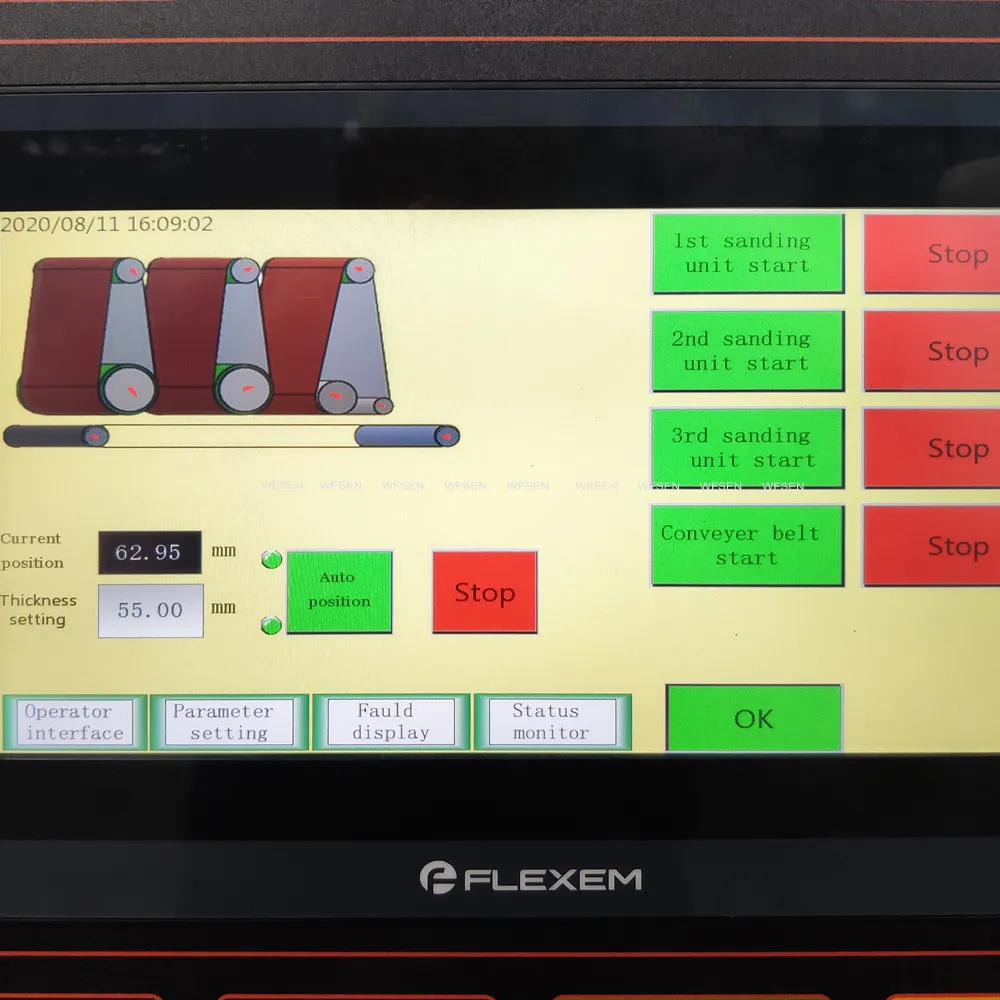
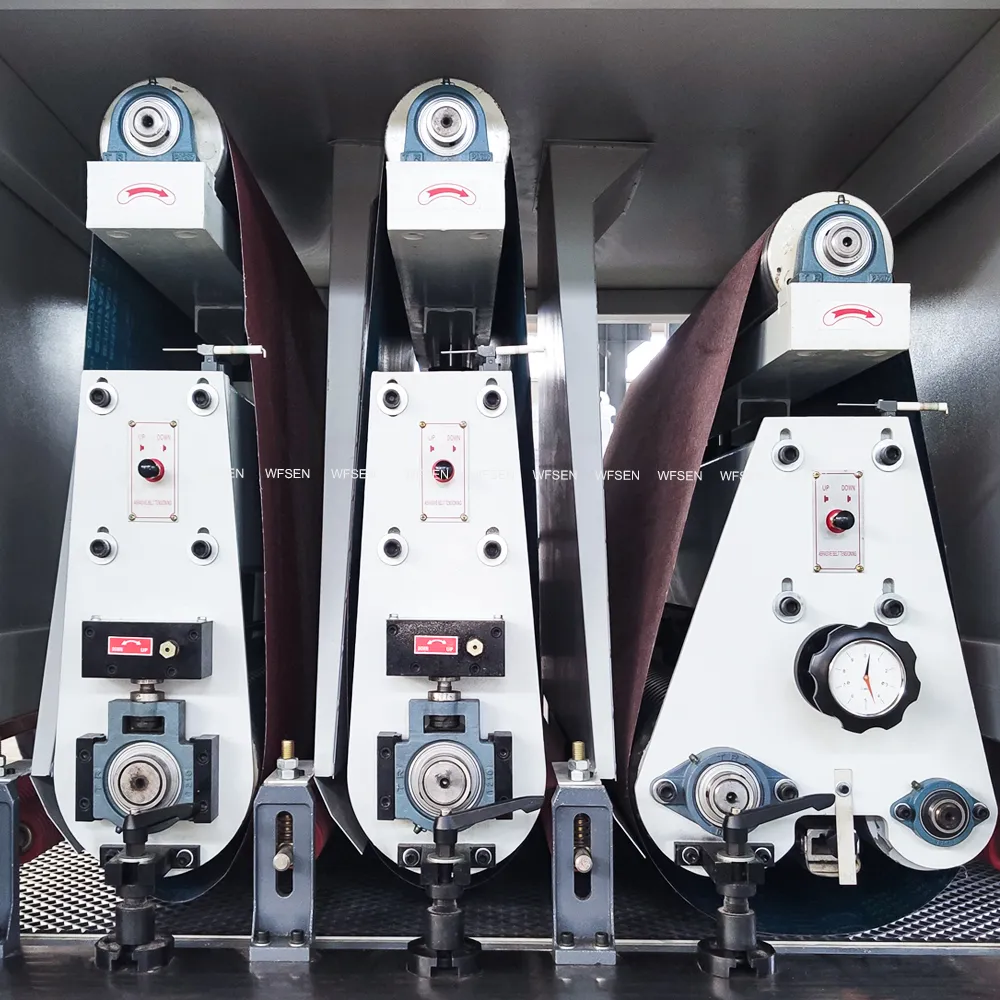
A wide belt sander does not hold one belt. The specification table on the R-R-RP1300 lists a first, a second and a third motor, sized 15/22, 37 kW then 11/15, 22 kW then 11, 22 kW. It lists a first, a second and a third roller at 190, 240 and 210 mm. Three motors, three rollers, three sanding heads — and one belt per head.
The control panel confirms it in plain English. The start screen carries separate buttons for the 1st, 2nd and 3rd sanding unit, each with its own stop, next to the conveyor belt start. An operator can run one head, two heads or all three.
The model code carries the same information if you know how to read it. Our two-roller machines are listed as R-RP, the three-roller versions as R-R-RP. On the top and bottom line there are two machines in sequence, an up sander and a down sander, and each publishes three motors of its own — 37 kW, 30 kW and 22 kW in both cases.
Plan your spares against the head count on your machine, not against the machine count in your shop. A three-head sander that runs two shifts needs a different shelf than a single-head bench machine, and the belts are the consumable that sets the rhythm.
Ask a supplier how fast the belt runs and you will often be handed a number like 6–30 m/min. That is the feeding speed on the R-R-RP1300 — the speed the conveyor drags the board through the machine. It is not the belt speed.
The one machine in this range that publishes a true belt speed is the MM2617 vertical belt edge sander, at 18 m/s with a spindle speed of 2890 r/min. Convert that and you get 1080 m/min — between 36 and 180 times the conveyor's speed, depending on where the feed control is set.
The gap matters when you are diagnosing a finish problem. A mark that repeats along the board is usually a conveyor or roller issue. A mark that repeats across the board, at a fixed spacing, comes from the belt itself. Two different speeds, two different patterns, two different repairs. Confirm both figures in the machine's own table before you blame the abrasive.
Published working thickness across the range is not the same either, and the smallest number decides more jobs than the largest one.
Half a millimetre separates the wide belt sander from the primer sander at the bottom of the range. If you are finishing coated panels, that half millimetre is the difference between a machine that will take your work and one that will not. Thin material will not pass under a head set for 3 mm, and forcing it risks a jam that costs more than the belt.
Our sanding pages say one thing about abrasives, and only one: different wood boards need different sanding belts. There is no grit chart, no joint type and no belt price published anywhere in this range.
That is deliberate, and it follows the split in who knows what. Belt geometry is a machine fact — it is fixed, published, and identical for every customer who buys that model. Grit is a process decision. It follows your material, the stock you remove, the finish you are building and the sequence your heads run in. A grit chart copied from a catalogue tells you what worked in someone else's shop.
So when you order belts, send your supplier the machine numbers and your process numbers together: the model and its published belt size, the number of sanding heads, your working thickness, whether the board arrives raw or already primed, and what your dust extraction pulls. Four of those five are on the machine page. The fifth is on the belt maker's own data sheet.
One commercial point worth making. Belt cost tracks length more than it tracks grit. A loop in an uncommon length is made for the order rather than cut from stock. The money you save buying a cheap belt in the wrong size is nothing next to the batch you ruin finding out.
No page in this range publishes a belt life in hours, and you should distrust any general figure you are given. Life depends on the board, the stock you remove, the grit you start at, how steady your tension is and how much dust you leave in the cut. Change the material and the same belt lasts a different length of time.
Replace on signal rather than on a calendar. The machine gives you warning in the cut, long before a customer would see it on a finished panel.
Two services set the pace of belt wear, and both are on the specification sheet.
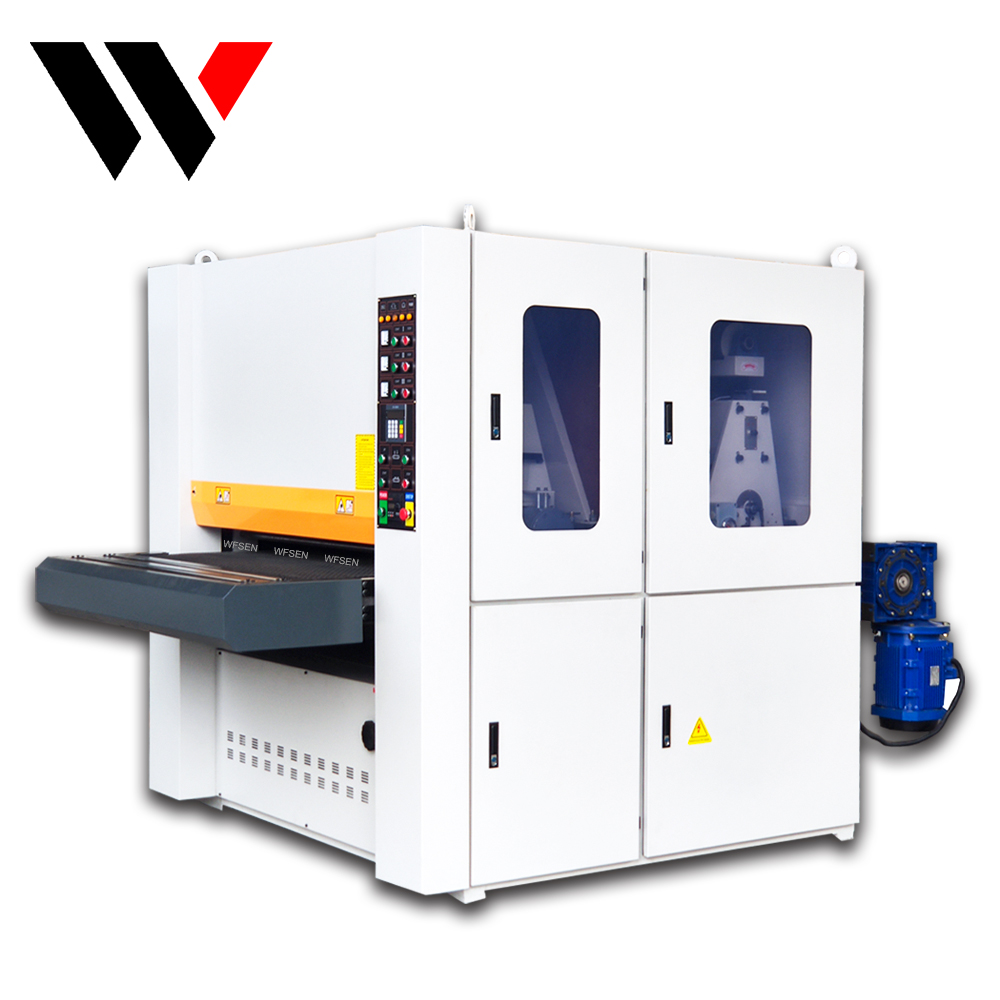
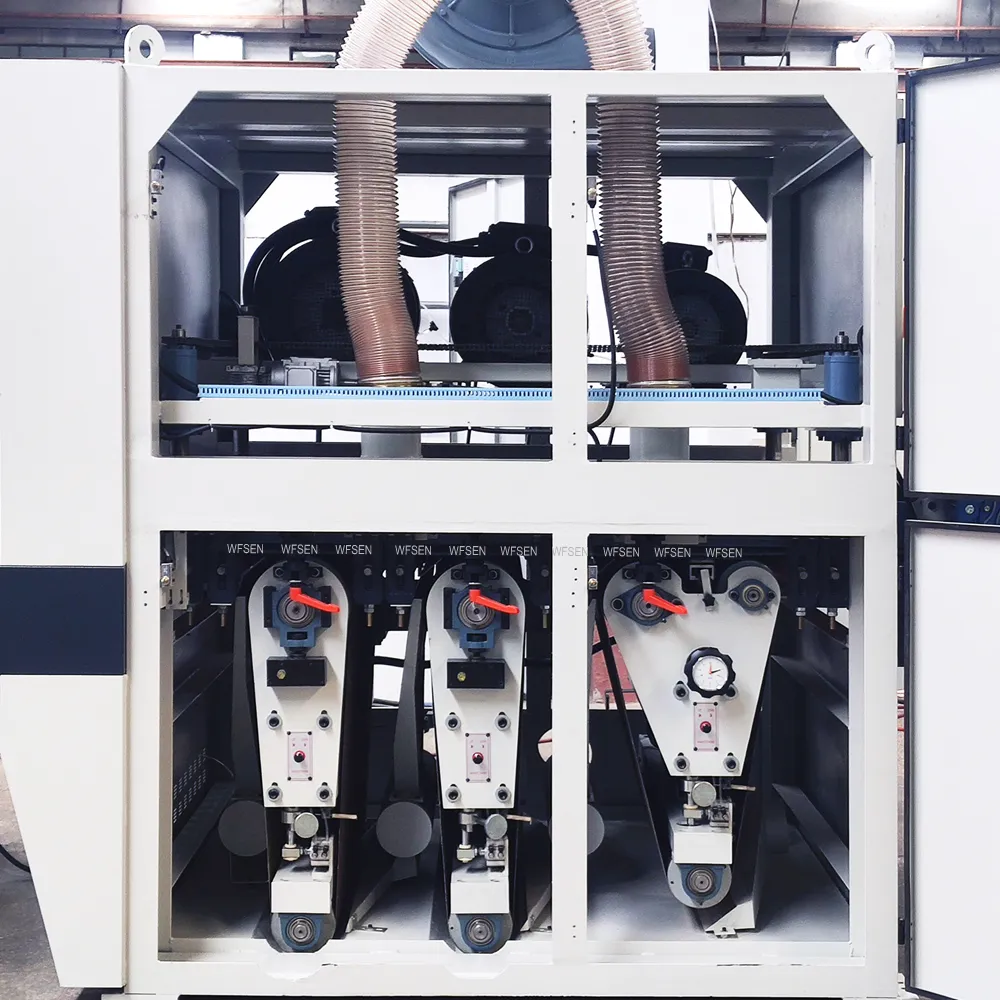
Dust first. The R-R-RP1300 lists a dust collector motor at 5.5 or 7.5 kW. The R-R1000 primer sander goes further and publishes a dust volume of 8000 or 9600 m³/h. Open the cabinet on the top and bottom line and you can see where it goes: each head carries its own flexible duct, because dust that is not pulled away at the contact point stays between the belt and the board, grinding both.
Air second. Working air on every machine in this range is published at 0.6 MPa — wide belt sander, planer sander, primer sander, and both units of the top and bottom line. Tension and tracking pressures come off that supply. A compressor that sags under load does not raise an alarm; it shows up as a belt that wanders and a finish that varies between shifts.
Six items, and you can settle five of them from the machine page before you speak to anyone.
If the machine is a top and bottom line, ask us for the belt size in writing. That figure is not on the page, and guessing from the 1300 mm working width would put you one loop length out.
Can I use the same belt on the wide belt sander and the planer sander?
Not at 1300 mm. The wide belt sander takes 1320 × 2020 mm; the planer sander and the primer sander take 1320 × 2220 mm. The width matches, the length does not.
Does changing grit change the size I order?
No. Grit changes the cutting surface, not the loop. Order the same published size whatever grain you are running.
How often should a belt be replaced?
On signal, not on hours. Watch for burnishing, a mark that repeats at one point on the loop, a setting that has to be closed further to hold dimension, tracking that will not settle, and dust loading that extraction does not clear.
Why not publish a grit chart?
Because grit follows your process rather than our machine. The same sander runs 80 grit on a raw board and 180 on a primer, in the same hour, with the same belt size.
Belt sizing is one detail in the wider choice of a finishing machine. The machine types and how they differ are covered under sanding machine types, and the full list with published specifications sits in the sanding machine range. If your finishing step runs to a brushed surface rather than an abrasive one, the equivalent comparison for that stage is covered in the wood polishing machine guide.
Send us your machine model, your working thickness and the board you are running to the WFSEN engineering team, and we will confirm the belt size and the head count for your machine in writing.