A three head wide belt sander is not three copies of the same station. Each roller carries its own motor, its own diameter and its own job, and the machine only works when those three jobs stay separate. Most sanding problems on a wide belt machine trace back to an operator asking the second or third head to do the first head's work.
Below is how the three heads divide the work on the R-R-RP1300 platform, what the numbers on the plate actually mean, and where a machine like this stops being the right answer.
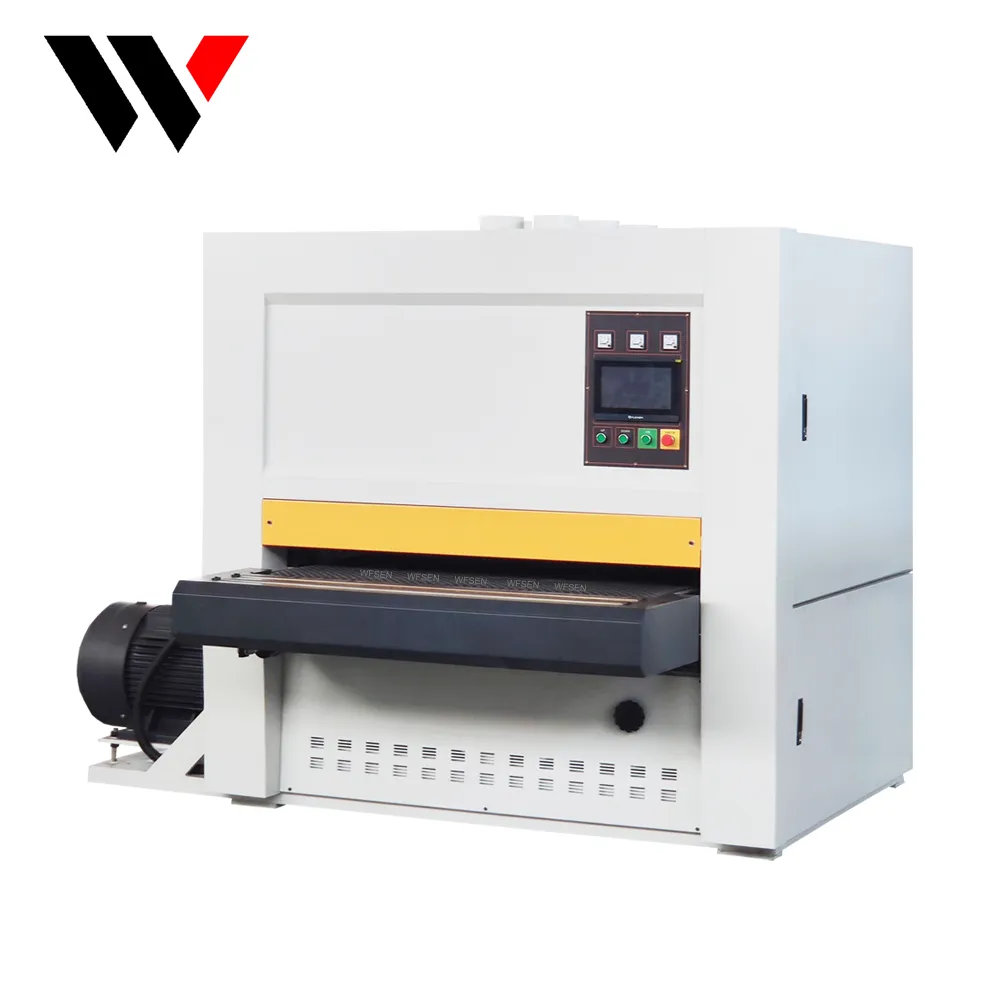
One head can sand a panel. It just cannot sand it twice as fast as half a head, and it cannot remove a machining mark and then polish the surface in the same pass with the same belt.
Three heads exist so that each stage of the cut gets a belt matched to it. The first removes caliper and the marks left by the thicknesser or the press. The second and third refine what the first produced. If all three carry the same grit, you have bought three times the motor and none of the benefit.
That is the whole design argument. Nothing else on the machine matters as much.
On the 1000 mm version the first head runs a 15 or 22 kW motor with a 190 mm roller. On the 1300 mm version it is 37 kW with a 240 mm roller.
The jump is not cosmetic. Spreading 37 kW across a 1300 mm cut is roughly 28 W per millimetre of width. The same 37 kW on a 1000 mm cut would be 37 W per millimetre. A larger drum and a wider belt change how the load is shared, and that is why the wide machine needs the bigger motor rather than the same one turning slower.
This is the head that sets your removal rate. If the first head is taking 0.4 mm per pass, the other two have almost nothing to do. If it is taking 0.05 mm, you are paying for two extra motors that polish scratches.
The second head is 11 or 15 kW on the narrow machine and 22 kW on the wide one, with a roller of 190 mm on one version and 210 or 240 mm on the other.
Its job is to make the panel a consistent thickness, not to take stock off. Run it heavy and two things happen at once: the belt loads, and the panel gets warm enough to move. A glued panel that moves between heads is a panel with a visible step in it.
Practical setting: the second head should touch, not cut. If you can hear it from outside the enclosure, it is taking too much. Touch, not cut. That is the whole setting.
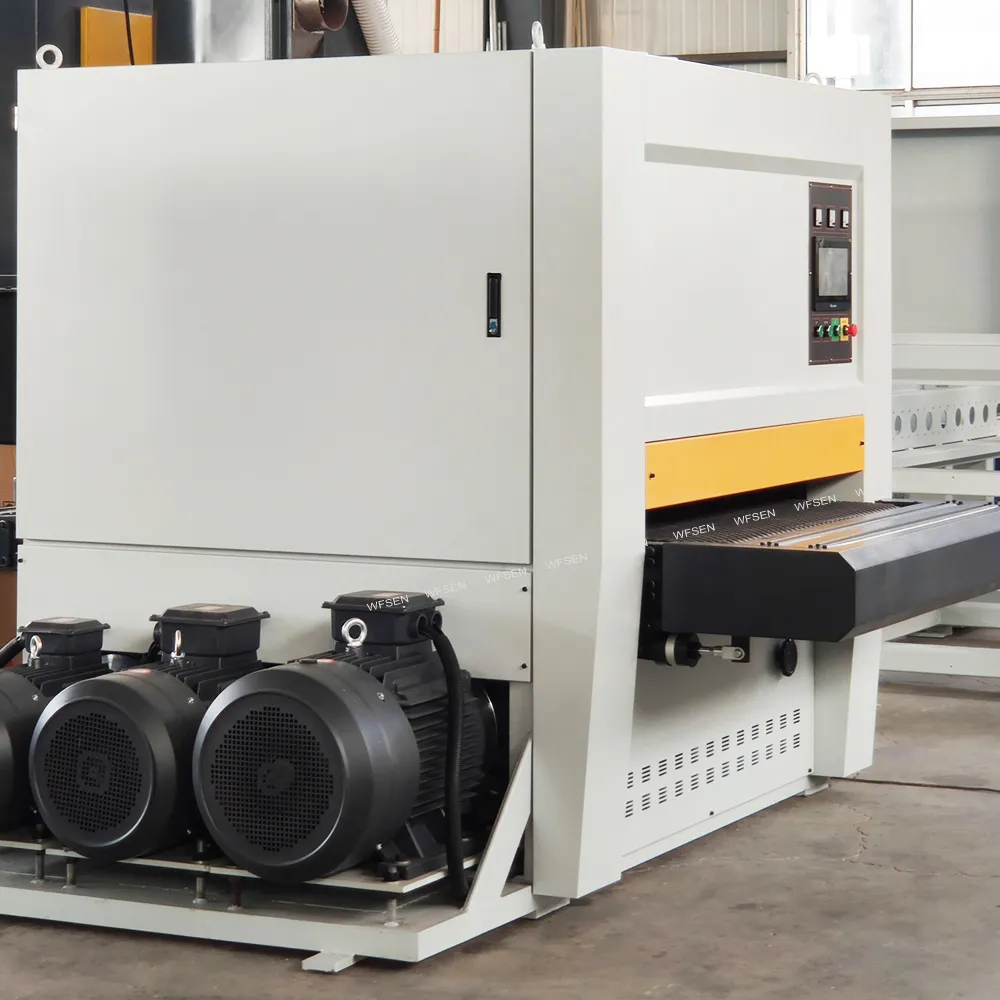
The third head is 11 kW on the 1000 mm machine and 22 kW on the 1300 mm, with a 190 or 210 mm roller. Belt size is 1020 x 2020 mm on the narrow machine and 1320 x 2020 mm on the wide one.
A longer belt runs cooler. That matters more than the grit number at this stage, because the failure mode on the third head is heat, not depth: a hot belt glazes, a glazed belt polishes instead of cutting, and a polished scratch is still a scratch. It is just harder to see until the lacquer goes on.
Three heads means three grits. The temptation is to jump from coarse to fine and save a belt change. Do not. Not even for one panel.
A 60 grit scratch under a 120 grit finish is not removed by the 120. It is buried. Buried, not removed. Then the panel looks acceptable in the shop, ships, gets lacquered, and the scratch telegraphs through the film. By the time anyone sees it the panel is finished goods.
The rule is boring and it works: each grit removes the previous grit's pattern completely, and the proof is a raking light across the panel, not a hand.
The feed runs from 6 to 30 m/min. The motor behind it is 1.5 kW on the 1000 mm machine and 4 or 4.5 kW on the 1300 mm, which tells you something about the load a wide panel puts on the conveyor.
Six metres a minute is slow. It is also the setting for figured timber, mismatched grain and anything where the belt has to cut without tearing, and it is where a surface finish that survives lacquering comes from in the first place. Thirty metres a minute is a production number: uniform stock, light cuts, one person feeding and one stacking.
Doubling the feed rate roughly halves the knife marks per metre, which sounds like an improvement until those marks line up into a visible pattern across the panel. The useful setting gives an acceptable surface at the highest speed your material allows, and finding it takes an afternoon with your own panels, a raking light and a straight edge.
Working air pressure is 0.6 MPa, and it is not optional. Belt oscillation keeps the abrasive from wearing a groove in one place on the drum, and tracking keeps the belt on the rollers. A shop that runs the sander off a small compressor shared with blow-off guns will see oscillation drop out at the exact moment someone else uses air. Give it its own supply. Its own, not shared.
Dust collection is rated 5.5 kW on the narrow machine, 7.5 kW on the wide one. A 1300 mm cut produces a wide, continuous ribbon of chips. Under-specify extraction and the machine fills its own hood within minutes. Then it stops cutting and starts polishing.
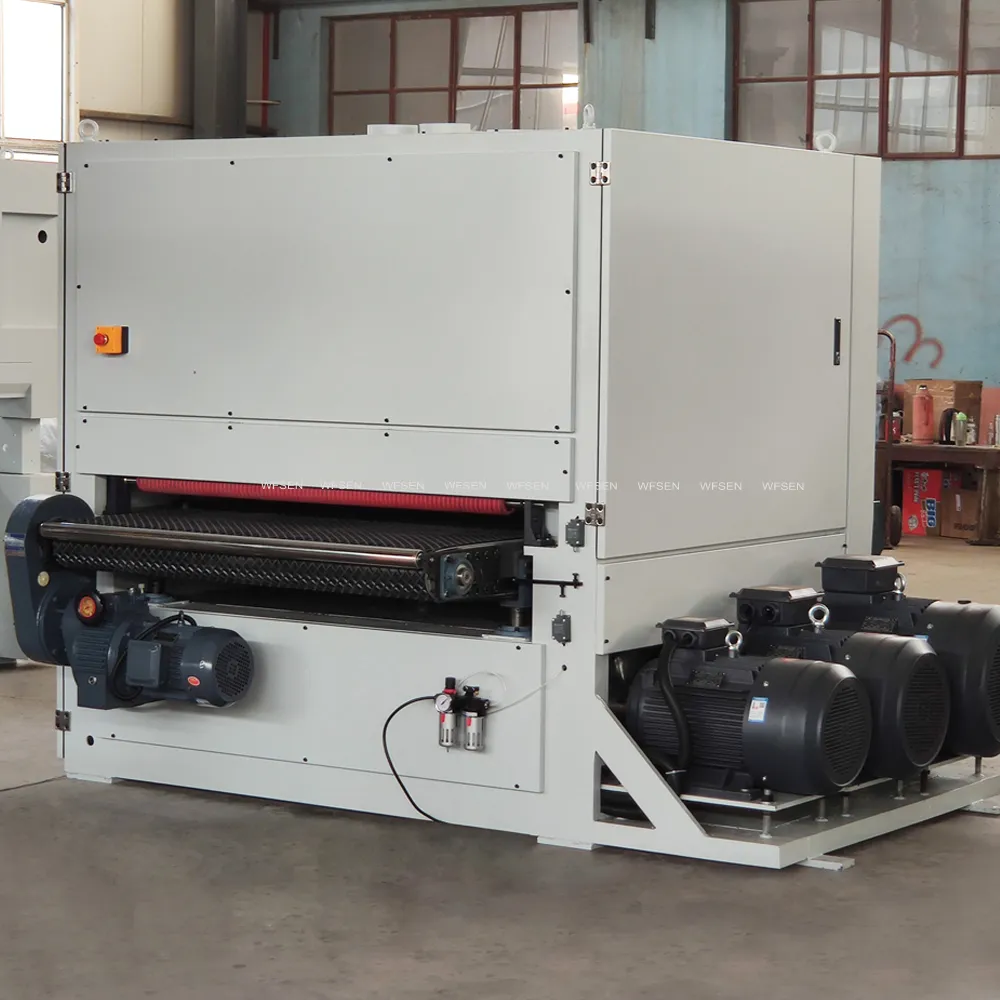
A two head machine will sand a panel. It will not do it with the same grit progression, and that is the only honest way to choose between the two configurations.
With two heads you have two grits. On a panel that comes off a press with a visible caliper band, that means the first head has to remove the band and leave a surface the second head can finish. It works, and it is slower, and the belts wear faster because each one is doing more of the job.
Three heads buy you a grit in between. That middle head is what lets the first cut properly rather than cautiously, which is where the removal rate comes from. On a machine with a 37 kW first motor and 1320 x 2020 mm belts, running that motor gently because there is no second stage to clean up after it is a waste of the machine you paid for.
So the question is not how many heads. It is whether your panels need a stage between rough and finish. Veneered and laminated boards usually do. Solid timber at a consistent caliper often does not, and then the third head is capacity you are heating the shop with. Nothing more than that.
Three limits worth stating. Working thickness spans 3 to 110 mm, so the machine is not a calibrating planer for thick stock. Minimum working length is 500 mm, which rules out small components run through lengthwise. And a sander removes caliper; it does not take twist out of a cupped panel.
Width is rarely the constraint. Flatness is. So is caliper, which the first head removes and the other two cannot.
If the panel is twisted, the fix is upstream. A wide thickness planer handles caliper on glued panels before sanding, and the press decides whether the panel was flat to begin with.
At 3200 to 4100 kg for the wide version, the floor matters too. That is a point load, not a distributed one.
Ask for the motor rating and belt size in writing for the exact version you are buying, because the table covers two machines and most rows carry two figures. Confirm the air supply and the extraction volume. Then take a panel you already know, run it at the feed speed you plan to use, and check the surface under raking light across the full width rather than in the middle.
The full parameter set sits on the R-R-RP1300 page. Ten minutes with your own material tells you more than the sheet does, because the sheet describes a machine and the panel describes your machine on your timber, in your shop, at the feed speed your operator will actually use. Ten minutes. Not an hour.