A 15 kW screw compressor, a refrigerated dryer and a receiver arrive on one pallet. Three weeks later the edge bander alarms on low pressure, and the owner calls the compressor cheap. It is not cheap. The purchase order was written backwards.
Air is the last utility a wood shop buys and the first one it blames. Dust extraction gets designed with the layout. Power gets sized by the electrician. Compressed air gets whatever is left in the budget after the machines are chosen. Three numbers then decide whether the installation works: pressure at the inlet, flow behind that pressure, and how dry the air is when it lands. Only the first one is printed on the compressor.
Not the saw. Not the spindle. The machines that need air are the ones nobody expects: the wide belt sander and the automatic edge bander.
Read the two sheets side by side. The R-R-RP1300 wide belt sander lists Working air at 0.6 MPa, on a spec line of its own. The MF360B full automatic edge bander lists Air press at 0.6 MPa, also on a line of its own. Different labels. Same number. Same decimal place.
That repetition is the most useful thing on either page, and it is easy to miss because the two machines sit in different folders here — one under sanding, the other under edge banding, while the compressor waits in others. Both machines were drawn by people who assumed 0.6 MPa would already be standing at the wall on commissioning day.
Six bar on a gauge. A working pressure, not a peak, and not the figure that sits on a receiver at seven in the morning before the first panel is loaded.
The distinction is where most arguments start. 0.6 MPa has to exist at the inlet while the machine is mid-cycle — clamp closed, belt running, edge pressed home — not in an empty line on a quiet afternoon.
Between the receiver and that inlet sit a dryer, a filter, a length of pipe, a few elbows and a coupler. Each one takes something out of the line before the air arrives. So the number on the bander is a floor. It is not a target.
Same inlet figure. Completely different appetite behind it.
The edge bander is a clamp and a glue pot. Air press at 0.6 MPa holds a panel against the fence while an edge goes on, and it works in bursts: one panel, a gap while the operator loads the next, another panel. The compressor sees a series of short, hard draws, and the receiver absorbs them.
The sander is the opposite shape of load. A wide belt runs for minutes, not seconds, and the pneumatic side of the machine holds its state for the whole run. Working air at 0.6 MPa on the R-R-RP1300 is a steady demand where the bander's is a chopped one.
A receiver sized for a bander is therefore not automatically right for a sander. The bander wants storage. The sander wants supply, delivered without a sag in the middle of a pass.
Rated pressure on the 15 kW unit is 0.8 MPa. The machines want 0.6. A buyer looks at the pair, decides the compressor is oversized, and goes shopping for something smaller — which is how a shop ends up with a unit that runs loaded all day, never rests, and is replaced two years early.
The 0.8 MPa is measured at the outlet, with the unit doing what the rest of the plate says. The 0.6 MPa is a requirement at the far end of a pipe, in another room, with hardware in between. Rated pressure is headroom the installation gets to spend on the dryer, the filter and the plumbing. It is not surplus sitting there for nothing.
A piston compressor holding 0.8 MPa in a small receiver and a screw unit holding the same pressure at 2.4 m³/min are not the same supply, even when the gauge reads identically. Pressure without volume collapses the moment a clamp closes.
Four lines off the plate: rated pressure 0.8 MPa, capacity 2.4 m³/min, rated power 15 kW, motor speed 3000 rpm. The frame is 1050 × 770 × 1080 mm. That is the machine, in one paragraph.
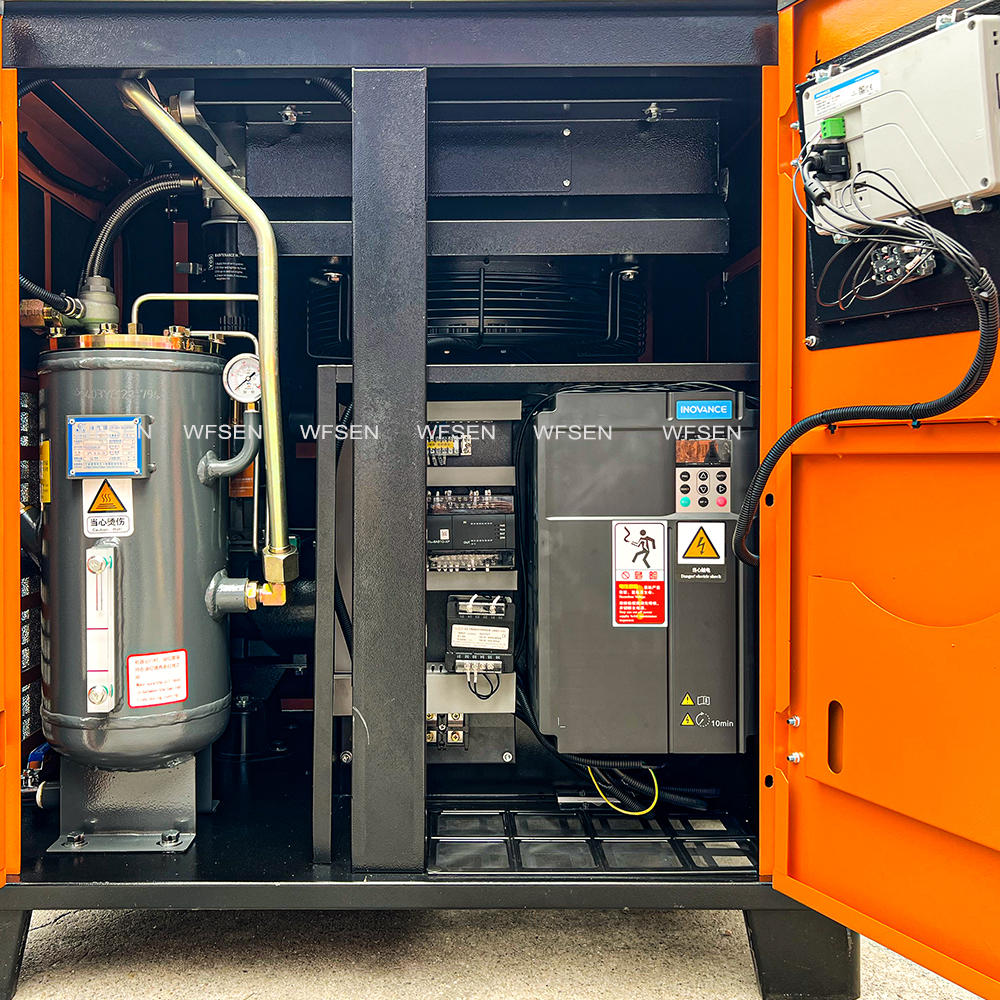
Capacity is the line argued over in every quotation meeting, and the one nobody on the buyer's side can check. Air consumption for the sander is not published on this site. Neither is consumption for the bander. So anyone who hands you a total invented it, spreadsheet included.
Ask the factory, in writing, for the consumption of the machines you own, then do the addition yourself. Two machines is a short list. Five machines off one header is a design job with a drawing.
The unit, with receiver and dryer on one drawing, sits on the 15 kW screw air compressor with air tank and dryer page.
A refrigerated dryer is a small fridge with an air path pushed through it. On the frozen type air dryer here that means refrigerant R134A, a charge of 460 g, 0.53 kW of compressor power, and a fan moving room air across the condenser. Air cooling, not water cooling.
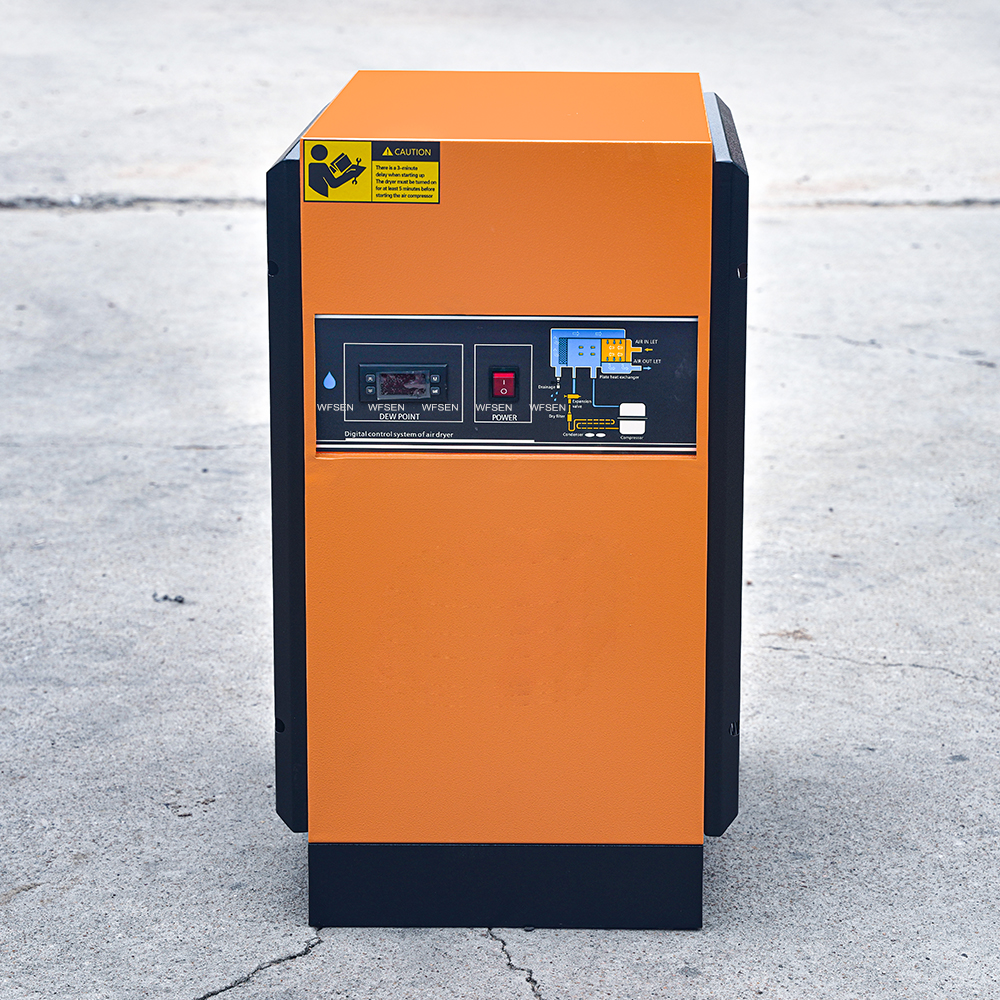
| Flow capacity | 3.6 Nm³/min |
| Working pressure | ≤1.6 MPa |
| Low point (dew point) | 2-10 °C |
| Inlet temperature | ≤65 °C |
Watch the units before you compare anything. 3.6 Nm³/min and 2.4 m³/min are not the same currency. Normal cubic metres are referenced to a standard condition, while the compressor's capacity is stated as drawn, so two figures can sit beside each other in a catalogue and still describe different things. Set them side by side anyway, decide the dryer is oversized, and the mistake turns up in July as water in the filter bowl.
Air leaving a compressor at 0.8 MPa is hot and close to saturated with water. Cool it and the water falls out. That is the whole function of the dryer, and 2-10 °C says how far down the air is taken before it is released into the line.
Where the number matters is not the receiver. It is the small parts. A glue pot that sees wet air. The cylinder behind an air press holding a panel at 0.6 MPa, with water sitting in the bottom of it. A line running cold through an unheated corner of the building in February. MDF dust plus water makes a paste, and paste in a valve body means a Monday morning with the side panel off.
Put the filter downstream of the dryer, never upstream. A dryer catching dust is a dryer not catching water, and a pre-filter nobody drains is worse than no filter at all.
Here is the strange part of this listing. The package includes a tank, and the tank's parameters are not published. Volume: not published. Working pressure: not published. Dimensions: not published.
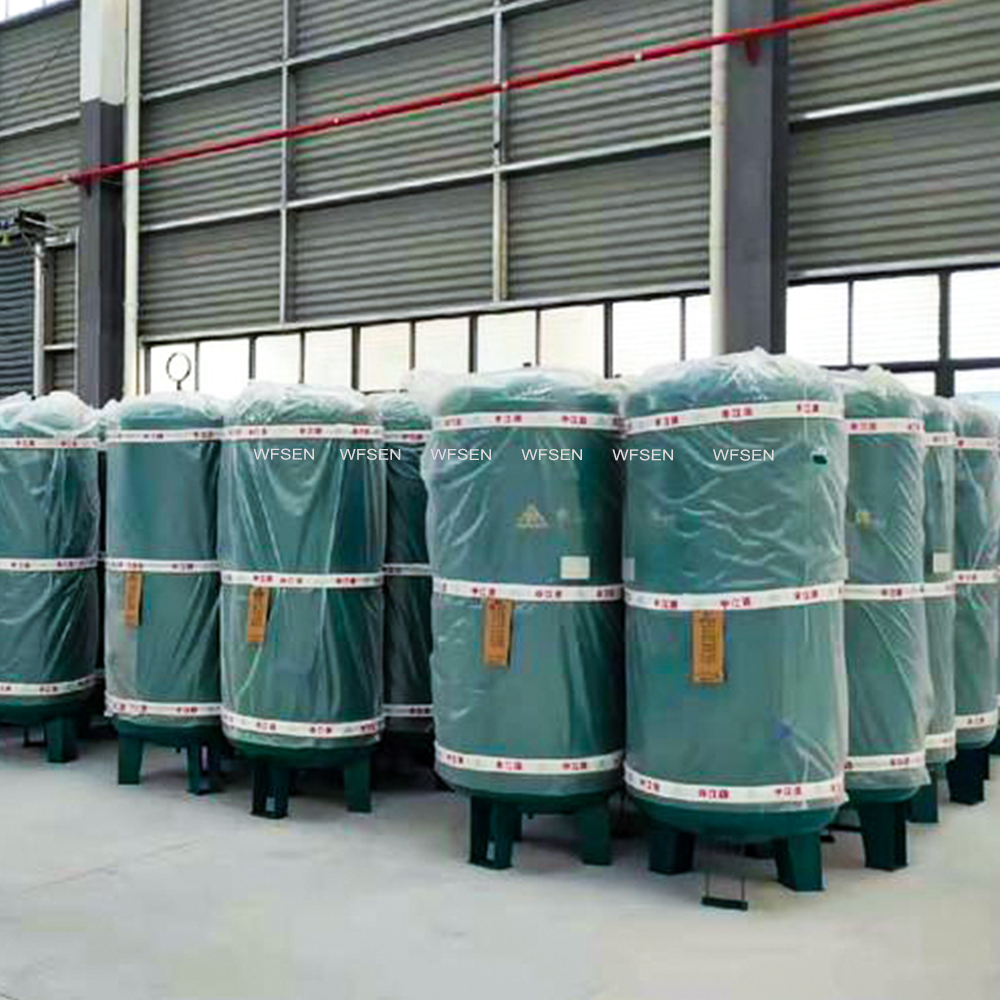
So do not plan a plant room around a shape you saw in a photograph. Ask for the data plate, in writing, before the concrete is poured. Then measure the bay. A receiver that does not fit ends up outside, on a pallet, connected by a hose somebody found.
The tank also sets how the compressor behaves. Storage is what lets a screw unit run loaded, then rest, instead of hunting every time a clamp closes.
Two footprints decide the room. The compressor is 1050 × 770 × 1080 mm. The dryer is 540 × 450 × 730 mm. Side by side, on paper, that looks generous.
Then the room fills itself. A receiver. A filter. A drain line that needs a fall to somewhere legal. Clearance in front of the panel door so a technician can stand there with both hands free.
Both boxes are air cooled, and the dryer's condenser and the compressor's cooler dump their heat into the same few cubic metres of a back room that usually has one louvre door and no through draught. Warm inlet air costs dew point long before it costs pressure. The sheet allows inlet up to 65 °C. A plant room in August gets close. The dryer then gives up its margin without an alarm.
Plan it alongside extraction. A cyclone dust collector and a compressor compete for the same back corner, and the collector wins that argument by volume every time.
Ask what pressure each machine needs at its own inlet, and write both figures on one line. Then ask what happens to 0.8 MPa between the receiver and that inlet. Anyone who answers "it will be fine" has not walked the pipe run.
Ask for the dryer's dew point at your summer ambient, not at a test bench. Ask what the receiver's data plate says, and accept only a document. Ask who will look at the drain trap in a year, because nobody ever does, and half the wet lines in the trade trace back to a trap that quit in the first winter.
Price the air system as one item, not three. The compressor has the motor and the noise, so it takes the attention. The dryer and the receiver decide whether 0.6 MPa at the bander is still 0.6 MPa in August, with the door shut and the fan running.