A buyer walks in with a short offcut in a plastic bag and asks for a finger joint machine. Two aisles over, another buyer holds a length of moulding and asks for the same thing, word for word. Both get a quotation. Only one goes home with the machine that matches the job.
The first buyer needs a joining line. Fingers cut on both ends, glue applied, a clamp closed, and a continuous board leaving the far side. The second needs a shaping station: a sliding table, a spindle, and enough throat to run a board past the tooling with nobody's hands near the cut. Same category page. Different departments of the factory.
That mix-up is expensive in a quiet way. Nothing breaks. The machine arrives, gets wired in, runs. Then the owner finds out that his stock is 600 mm wide and the clamp will not open past 150 mm, or that he has bought a stationary shaper when what he wanted was an inline gluing line. The two models in the finger joint machine category exist for exactly that reason.
Everything about the joint is settled before anyone opens a glue bucket. A cutterhead mills tapered fingers onto each end. The fingers interlock, glue wets both faces, and clamp pressure squeezes the excess out of the seam. Bad geometry cannot be pressed into a good joint.
Most shop arguments are about cutter profile. They should be about length. A setup that behaves on a short offcut will misbehave on long stock, because the longer the piece, the harder it fights the clamp. Long stock lifts at the tail. It creeps sideways. It leaves a glue line you can feel with a thumbnail, and the line comes back six weeks later when the panel goes through a planer.
Clamp force is the other half of it. On the MH1525F the figure is 4000 kg of oil pressure, applied across a working width band of 35-150 mm. That is not a number you can fudge with a foot pedal.

Read the MH1525F sheet from the top. Max working length 2500 mm. Max working width 35-150 mm. Max working thickness 12-50 mm. A Φ300 mm saw squares the end before the cutter touches it. Feeding speed 1.5 m/s. Total power 5.7 kW. Footprint 4400 × 1100 × 1500 mm. Weight 1000 kg.
The 2500 mm figure decides your building layout, and it is the line most buyers skim past. A machine that accepts 2500 mm needs infeed and outfeed room in proportion, and the 4400 mm body is only part of that. Drop it into a bay sized for a bench machine and the operator spends the shift turning stock end for end in a corridor.
Feeding speed 1.5 m/s describes the feed, not the output. Output depends on how fast a human can present the next strip, how often the cutter needs attention, and whether the glue station keeps pace. Any supplier quoting boards per hour without asking those questions is guessing.
Full specs sit on the MH1525F full automatic finger joint machine page.
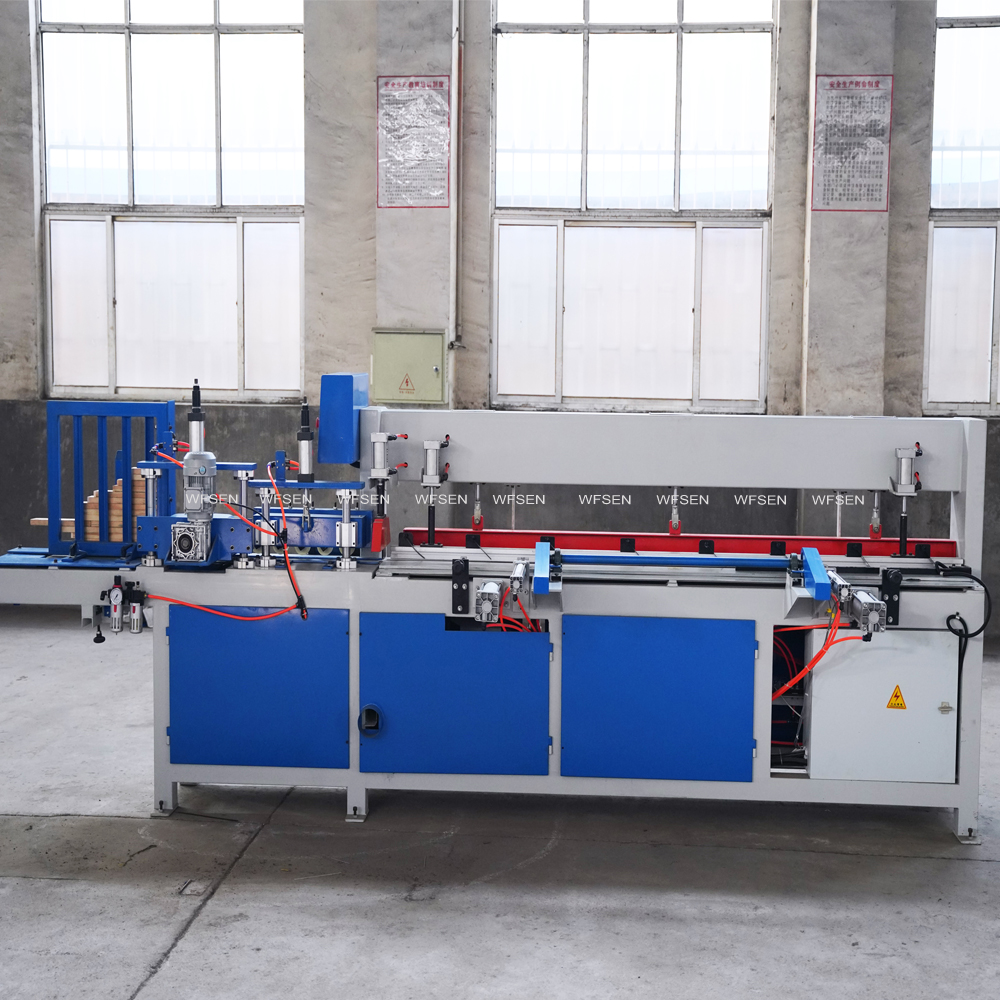
Buyers see 35-150 mm and hear "small". Turn it around. A 150 mm ceiling tells you the machine was drawn for strips, moulding blanks and narrow laminations, and every part of the clamp was sized for that work. Narrow stock means short clamp travel. Short travel means less flex in the beam while 4000 kg of oil pressure is doing its job.
If your parts are wide panels, this is the wrong purchase, and no amount of clever fixturing rescues it. If your parts are strips that have to become long strips, the narrow clamp is the reason the seam closes flat.
Thickness runs 12-50 mm. Under 12 mm the fingers get fragile and cut quality depends on cutter sharpness more than on the machine. That is a material fact, not a machine limit.
Both models weigh 1000 kg. One has a 150 mm working width. The other has 600 mm. That contrast is the most useful thing on either sheet, and it says nothing about build quality.
Mass follows the job. On the MH1525F the steel sits in a long clamp beam and a 4400 mm frame that has to stay straight while 4000 kg pushes through it. On the MX3515F the steel sits in a 600 mm sliding table and a spindle housing rigid enough to hold an 11 kW shaft at 6000 r/min. Same kilos, different place. Weighing a machine and calling the heavier one better is the oldest mistake in a machinery hall.
The dimensions repeat the point. The line is long and thin at 4400 × 1100 × 1500 mm. The shaper is short and broad at 2800 × 1500 × 1600 mm. Neither shape is an accident.
| Working width | 35-150 mm | 600 mm max |
| Working height or thickness | 12-50 mm | 150 mm max |
| Main drive | 5.7 kW total | 11 kW spindle |
| Weight | 1000 kg | 1000 kg |
| Overall dimensions | 4400 × 1100 × 1500 mm | 2800 × 1500 × 1600 mm |
Now the other trade. Max working width 600 mm. Max working height 150 mm. Shaper spindle Φ40 mm, 11 kW, 6000 r/min. Sliding table 0.75 kW. Big saw 3 kW at 2840 r/min on a Φ30 mm spindle. Small saw 0.75 kW on a Φ20 mm spindle.
Eleven kilowatts on one shaft is almost double the whole power draw of the joining line, and all of it goes into a single cutterhead turning at 6000 r/min. That is a shaping machine. The two saws bracket the spindle: the big saw takes the heavy trim, the small saw handles the finer cut, and the powered sliding table carries the work past both.
A 600 mm table is what makes it a different animal. You can present a wide blank, run the profile, and keep your hands on the carriage handle instead of on the stock. It is also why the machine is 1500 mm wide and 2800 mm long. The width went into the table, not into a conveyor.
Model detail lives on the MX3515F finger shaper machine page.
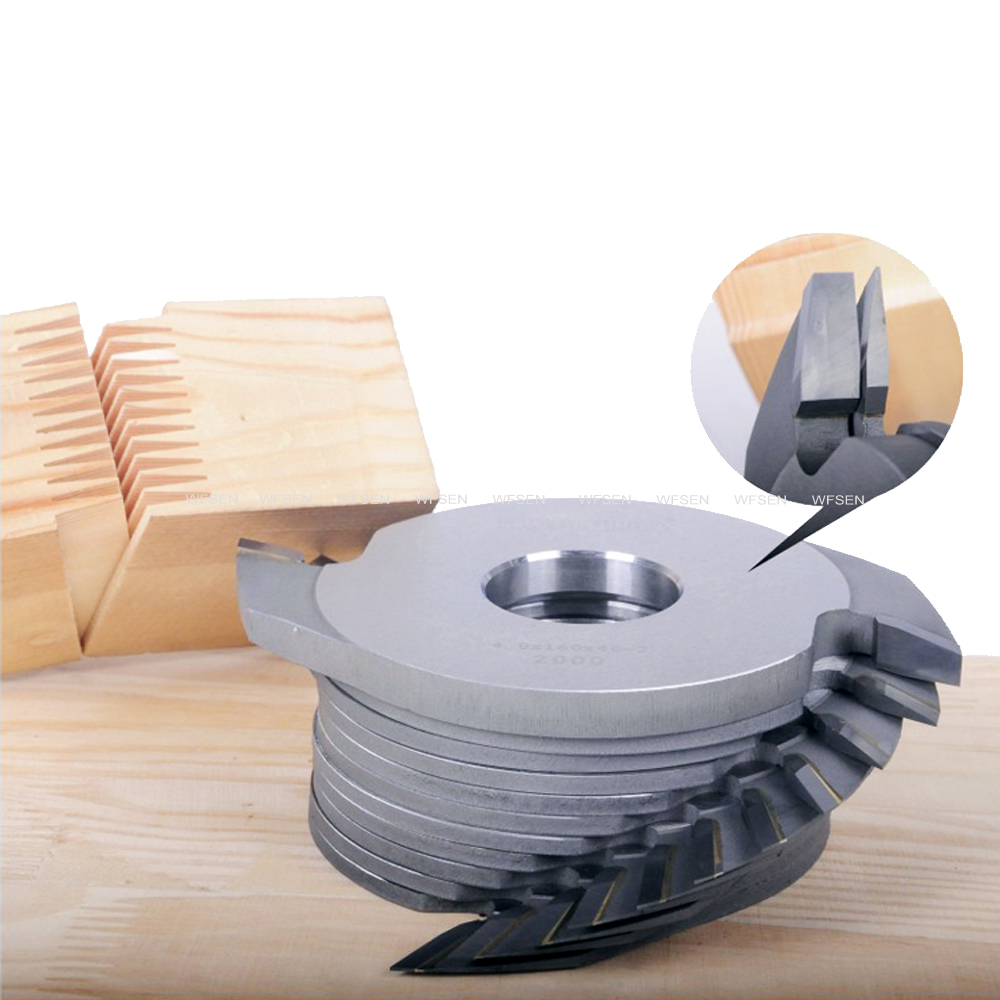
A finger joint cutter is a matched set, not a commodity blade. The profile has to suit the material, and the bore and diameter have to suit the shaft it bolts onto. On the MX3515F that shaft is Φ40 mm at 6000 r/min. A cutter built for a slower spindle has no business on it.
Ask three things before ordering tooling. What is the finger pitch, in millimetres, on the drawing? What is the bore? What spindle speed is stamped on the body? A supplier who answers "standard" is telling you he does not know.
Keep a spare set on the shelf. A dull cutter never fails loudly. It burns the finger flanks, glue cannot wet a burnished surface, and the joint tests fine on the bench and lets go in service.
The joining line does not finish the job. It hands off. Glued assemblies go to a cold press for room-temperature curing, or to a hot press when the panels have to leave the clamps the same shift. Neither choice is about machine quality. It is about how much floor you can give to work in progress.
Then the panel gets flattened. A multi planer upstream of the joint, running strips to consistent thickness before they are cut, does more for joint quality than any clamp upgrade. A fraction of a millimetre of variation becomes a visible step after glue-up.
Sequence beats any single machine. Rough mill, dry, plane, cut fingers, glue, press, flatten. Skip the plane and you will blame the cutter. Skip the dry and you will blame the glue.
Total power on the MH1525F is 5.7 kW. On the MX3515F the spindle alone is 11 kW, with 3 kW on the big saw, 0.75 kW on the small saw and 0.75 kW on the sliding table. Total connected load for the shaper is not published, so get it in writing before an electrician is booked.
Two figures are usually missing from a catalogue: compressed air consumption and dust extraction volume. Neither is published for these models. Both change the cost of the installation, and both are answerable in one email to the factory.
Floor loading matters just as much. 1000 kg spread along a 4400 mm frame is not the same point load as 1000 kg on a 2800 mm base. If the machine is going on a mezzanine, that difference is the whole conversation.
Bring your own stock to the demonstration. Not a sample the seller prepared. Your offcut, your width, your thickness. Watch the clamp close on it. Watch what happens at the tail.
Ask what the maximum working length does to the room you have. Ask who sets the cutter and how long a changeover takes with the tooling you will actually run. Ask for the wiring diagram and the air specification before you sign anything.
Then pick the job, not the machine. Long stock joined end to end, or wide stock shaped past a spindle. That answer chooses the model. The rest is negotiation.