A 1325 router looks solved on paper. Then three quotes land and none of them line up. Same table size. Same price band. One machine carries a single spindle, another carries four. That gap decides what you can cut, how fast you can load a sheet, and how much floor you hand over.
Working size, spindle count, vacuum zoning. Everything else on the spec sheet is downstream of those three choices. Buyers tend to argue about the controller first, which is backwards. A Taiwan LNC control will not save a table that is too short for the panel you cut every day, and it will not hold a part the vacuum cannot pin down.
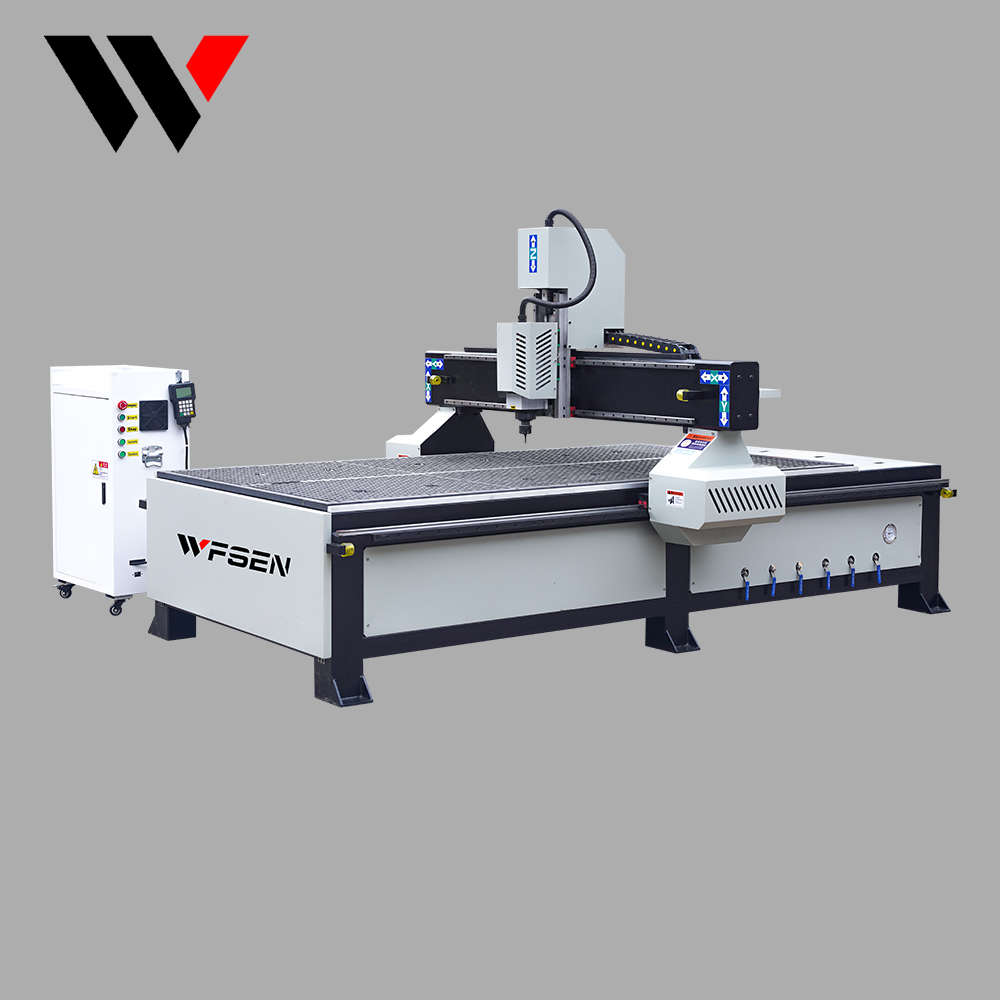
The KS1325A and the KF1325A make the argument better than any diagram can. They share a footprint. They share a vacuum figure. They split on spindle count, and that split runs through the whole buying decision. Both sit in the same cnc router range on this site.
Start with the table.
A machine that cannot accept the part is not a cheaper machine. It is a wrong machine with a discount on it.
The KS1325A lists a working size of 1300 × 2500 mm. The KF1325A lists 1300 × 2500 × 200 mm. That third figure is the one people skip, and it decides whether a thick block passes under the gantry or has to be machined somewhere else entirely.
Working size is not footprint. Overall dimension on both machines is 3500 × 2400 × 2000 mm. Put that on the floor plan before you put the working size on the quote. A 1300 × 2500 mm bed wants clearance at the loading end and walking room along the gantry side, and shops that skip this step end up moving a wall, a compressor, or both.

Measure the widest part you truly cut. Not the widest part you might cut someday. Shops buy for the someday sheet and then run narrow strips for a year.
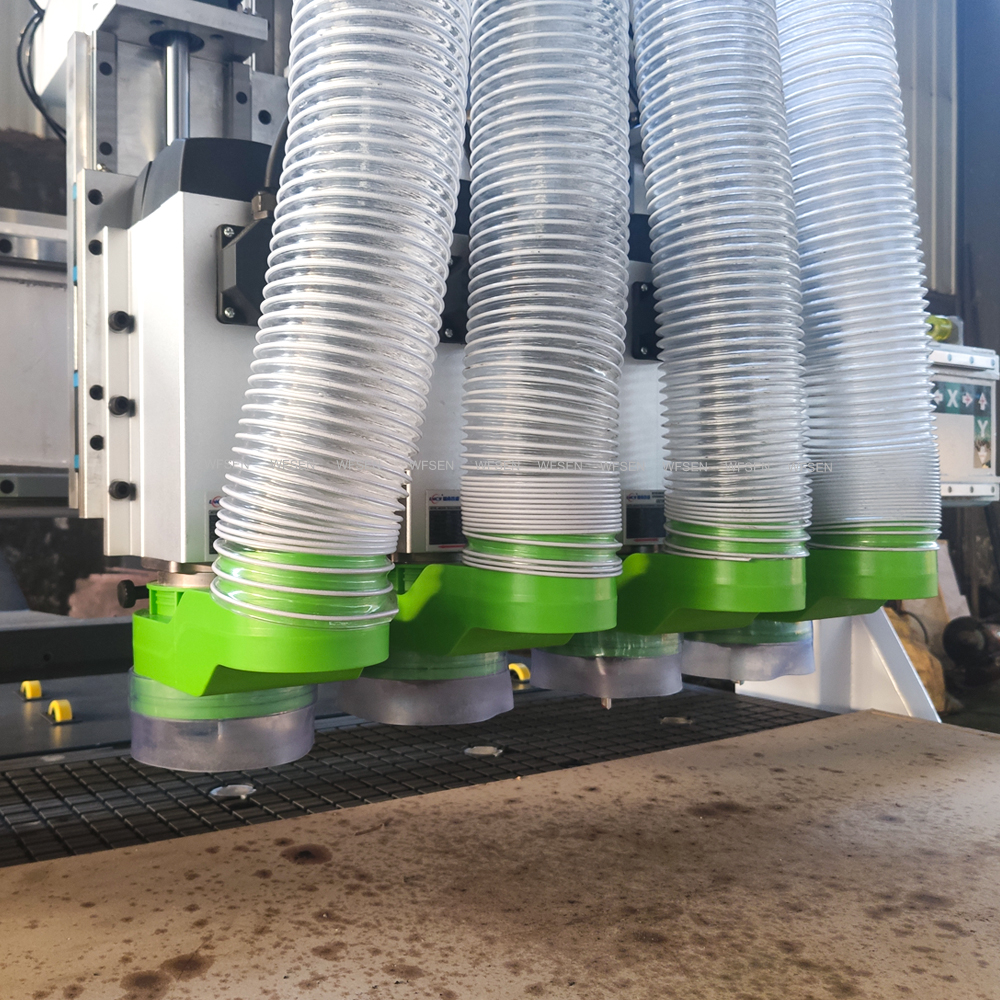
KS1325A: spindle number 1, spindle motor 9 kW with 12 knives, one servo motor at 1.5 kW. KF1325A: spindle number 4, spindle motor 6 kW × 4, servo 1.5 kW × 4. Same table underneath. Different economics on top.
Four heads buy throughput on repeated parts. Four identical cuts in one pass, or four tools already staged and waiting, so nothing queues behind a change. They also buy setup time and a longer commissioning afternoon, because every head has to be trammed and every tool has to be set before the first good part comes off. On work that changes every hour, a single head is often faster in practice. Less to reset. Fewer ways to be wrong at the start of a run.
On a panel that runs all week, the four-head machine wins on repetition alone.
Both machines list a vacuum motor of 7.5 kW with 6 areas. Identical on paper. That is usually where the comparison stops, and it is the wrong place to stop, because the number that matters is not the motor. It is how the bed is cut up.
Six areas means six independent zones under the sheet. A small part gets pinned by the zone beneath it while the rest of the bed stays open and uncovered. A single-zone bed forces you to mask off everything you are not cutting, with film and tape, every time the job changes. That cost never appears in a quotation. It appears in the last hour of every shift.
Think about your smallest part instead of your largest sheet. A 1300 × 2500 mm bed swallows a full panel without complaint. The question is whether it still holds a narrow offcut in the far corner while the gantry travels at 20000 mm/min. Thin stock is the usual failure case. The vacuum pulls, the part lifts a fraction, the cut wanders, and the scrap bin fills. Geometry beats motor size here.
The KS1325A pairs its 9 kW spindle motor with an 11 kW frequency converter. The KF1325A pairs four 6 kW spindles with a 7.5 kW converter. Read those two lines together, because the converter has to carry the spindle load and the pairing says how the electrical side was sized.
Then check the supply. A 9 kW spindle plus a 7.5 kW vacuum motor, running next to the dust collection and the compressor you already own, is a load an electrician has to see before the machine is ordered rather than after it is standing on the floor and the panel will not hold. Ask for the electrical schedule in writing. A supplier who cannot produce one has not built many of these.
Working speed on the KS1325A is listed at 20000 mm/min. That is a machine figure. It says nothing about the feed rate your oak or your acrylic will tolerate, which comes from chipload, tool diameter, and how firmly the sheet is held. A fast machine on a poorly held part produces scrap faster.
Position precision on both models is ±0.02 mm. That is the number that reaches the finished part. Guidance on the KS1325A is Taiwan HWN lead rail and slider, and the control is Taiwan LNC. Accuracy rests on those parts, on how the frame is leveled, and on the condition of the tool. The operator still sets the ceiling.
The KS1325A weighs 3000 kg. The KF1325A weighs 3200 kg. Mass is not a vanity figure on a spec sheet. A heavier gantry deflects less when a 9 kW spindle bites into hardwood, and a heavier base walks less across the floor during a long run.
It also sends more vibration into the building. Ground-floor slab, yes. Mezzanine, think again. Same 3500 × 2400 × 2000 mm overall dimension on both, so the shipping container does not care which one you pick. Ask the slab, not the catalogue.
The KF1325A page lists tool change at 0 second, with automatic tool change. Read that as a staging claim rather than magic. Four spindles ride the gantry, so the next tool is already in position. Nothing swings across the table. Nothing waits.
Where the saving shows up is between operations on nested work with several toolpaths in one file. Where it does not show up is a job that runs one cutter from the first cut to the last. Same machine, different value, decided entirely by the file you send it.
Two more names belong in the same conversation. The FS1631A CNC router with saw blades covers work where a saw cut and a routed edge happen on one table without a second setup. The KC1325A CNC carving machine is aimed at shaping rather than panel breakdown. Their specifications are published on their own pages, so check them against the part you actually make.
Neither one replaces the sizing logic above. A saw blade does not change how much table you need, and a carving head does not change how the vacuum is split.
Measure the widest and longest part that ships. Then measure the thickest block, because that is what decides whether 200 mm of Z travel is enough for the KF1325A or irrelevant to the KS1325A.
Write down the smallest part the vacuum must hold. Zone count helps, but a small part sitting at the edge of a zone is still a small part, and no 7.5 kW motor changes that geometry.
Count the tools in one job. One cutter points at the single-spindle machine. Several cutters on a repeating pattern point at the four-spindle machine, and the 0 second change starts earning.
Send the electrical schedule request with the inquiry. Send the loaded weight question too. A 3000 kg machine and a 3200 kg machine arrive on the same footprint but not on the same truck, and the rigging quote will reflect it.
Then plan the step after routing. Edges still need work, and a sanding machine is where most shops lose the hours they saved on the table. Sizing a router without sizing the finishing bench behind it is how a fast machine ends up feeding a slow line.
Three numbers, then. Table, spindles, vacuum zones. Get them in that order and the rest of the quote reads cleanly. Get them out of order and you will be arguing about the controller while the real problem sits under the sheet, unfixed and unmoved.