Five machines on one frame sounds like a bargain until you read the motor line. The MJ300T and 400S list a saw, a shaper, a mortiser, a planer and a thicknesser, and then list total power as 3 × 2.2 kW on one variant and 3 × 3 kW on the other. Three motors. Five functions.
That single line explains almost everything about how a combination machine actually behaves in a workshop, and it is the line the brochure photographs never point at.
The five functions are saw, shaper, mortiser, planer and thicknesser. Two model variants, MJ300T and 400S, sharing one layout and splitting on size: 700 kg against 800 kg, overall dimensions 1700 × 1200 × 1100 mm against 2000 × 1300 × 1100 mm.
Read the list as a workshop, not a feature set. Breakdown, edge shaping, joinery, face flattening and thicknessing in one footprint. For a shop cutting ten doors a week, that is the whole process on one machine. For a shop cutting two hundred, it is a queue.
A 3 × 2.2 kW arrangement means each function does not get its own drive. The load is shared across three motors, so the saw never sees the full installed capacity and no two heavy cuts happen at once — which is fine, because one operator only has two hands anyway.
What it changes is expectation. A 2.2 kW saw will cut 40 mm oak if you feed it properly. It will not cut it at the speed a 5.5 kW panel saw does, and buying the machine expecting that speed is how owners end up disappointed by a tool that is doing exactly what its motor allows.
3 × 3 kW on the larger variant is not 50 percent more per function. It is a bigger motor set behind the same shared arrangement, and the honest way to read either line is as a ceiling for the whole machine rather than a promise per station.
The thicknesser lists a maximum cutting height of 4 mm. The planer lists a maximum table adjustment of 4 mm. Different stations, same number, and it is the number that decides how a day in the shop goes.
Four millimetres per pass. Take a 100 mm board down to 80 and that is arithmetic: five passes, plus the flip. On a heavy planer-moulder the same reduction is two passes. So a combination machine is not slower because it lacks power. It is slower because each pass removes less, and the operator's hands are the feed system.
Nobody hides this. It sits in the table in plain figures. Buyers just read past it on the way to the function count.
Blade diameter 300 × 30 mm, cutting width against the parallel fence 500 mm on the MJ300T and 730 mm on the 400S, sliding table 1250 mm or 1800 mm. Sawing works at 90° and at 45°.
The sliding table figure is the one to weigh. A 1250 mm carriage covers most cabinet work and leaves a metre and a quarter you cannot crosscut in one stroke. The 1800 mm version covers a 2440 mm panel only with a reposition — so neither is a panel saw, and neither is meant to be.
There is also an engraver blade listed at 90 × 22 mm on a 4500 / 7000 rpm shaft. Grooving and dado work on the same table. Useful, and not a function anyone mentions when they count to five.

The planer side runs a 70 mm cutter block at 5700 rpm over tables of 300 × 1500 mm or 400 × 1800 mm. Long tables, and the right way round: flattening a face needs length in front of and behind the cut, and 1500 mm gives a twisted board somewhere to sit while the knives take the high spots.
The thicknesser side runs 4–220 mm of working height at 7 m/min over tables of 300 × 660 mm or 400 × 760 mm. Short. Feed a three-metre board through 660 mm of table and the ends will find every gram of flex in the arrangement. Support them. It sounds obvious and it is the most common cause of snipe on a machine like this.
Both stations stop at 4 mm of cut. Take 4, check, turn the board, take another 4. That is the routine, and it is a hand-fed routine from the first pass to the last.
Standard shaft diameter is listed as 30 / 35 / 50 mm, with a vertical stroke of 115 mm and a maximum tool diameter of 180 mm. Working tables 220 × 1000 mm or 290 × 1112 mm.
Three shaft sizes cover the common cutter bores without an adapter, which matters more than it sounds. A 50 mm shaft under a 180 mm tool is a lot of cutter swinging on a table that also has to serve as a planer, so the fence and the guarding deserve a hard look before the first profile cut rather than after.
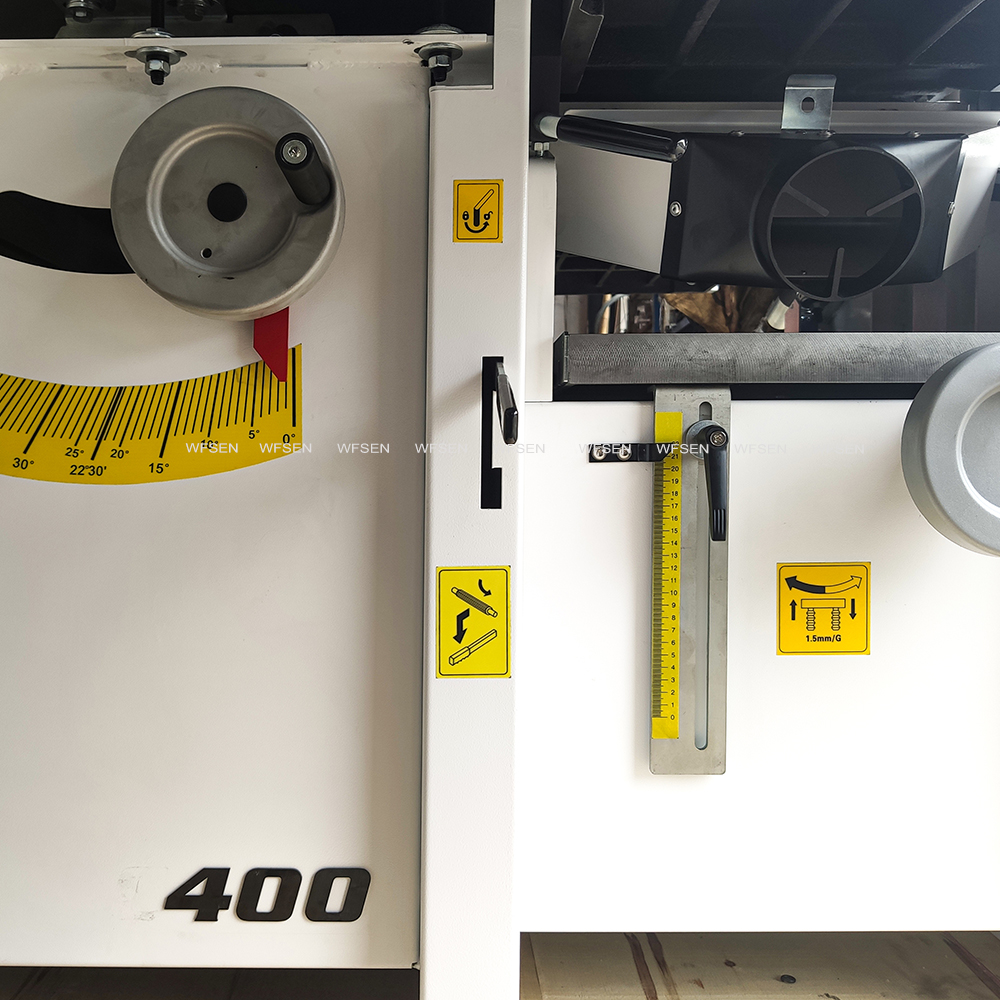
Longitudinal stroke 205 mm, transverse 95 mm, vertical 90 mm, chuck capacity 0–16 mm. That is a hollow chisel setup, and 205 mm of travel along the fence is enough for hinge positions and railing stiles without re-clamping every time.
Compare it against a dedicated mortiser only if you cut hundreds of joints a week. Below that, having the station already bolted to the same frame is the whole argument. Chisel work, this. For hinge boring and line drilling in flat panels, the drilling machine range is the place to look.
Seven hundred kilograms for five functions. A single dedicated 400 mm thicknesser weighs more than that on its own, and a four side moulder of any width starts where this machine finishes.
Light is the design, not a flaw in it. A frame you can move with a pallet truck and power from a normal workshop supply is the point. The trade is rigidity. Expect to take lighter cuts, expect vibration to show up in the finish on hard stock, and expect the machine to reward an operator who listens to it.
Five functions on one frame share one work surface. Moving from sawing to planing means clearing the table, changing or lowering the tool, resetting the fence, and checking the guard. Ten minutes if you are organised. Half an hour if you are not, and longer on the first few changeovers of the week.
Which is why the machine suits batch work and punishes mixed work. Twenty cabinet sides in one setup is fine. Ten different operations in an afternoon is a day spent setting up and very little time spent cutting.
Plan the order of operations before the wood arrives. Saw, then plane, then thickness, then shape, then mortise. Every shop that gets along with a combination machine works to a sequence. Every shop that fights with one changes its mind mid-batch.

A shop running one operation all day should buy one machine. That is not a criticism of this one. If ninety percent of your hours are on a thicknesser, a combination unit gives that operation 2.2 kW and a 660 mm table when it could have 7.5 kW and a metre of cast iron, and no amount of clever layout recovers that difference over a year of production.
A shop with floor space and three-phase power should also think twice. The machine exists because space and supply are expensive. Where they are not, dedicated stations win on rigidity and on setup time.
Where it earns its place: site work, small cabinet shops, boat yards, anywhere the machine has to be moved, and any workshop where a five-station process currently happens on three borrowed benches. The MJ300T and 400S page carries the full table for both variants, and the rest of the range sits under saw machine.
If your planing volume is real rather than occasional, compare this against a dedicated surface planer and read the three planing machines compared before you decide. Past that volume, a four side moulder doing the work of three machines is the honest comparison. Five functions is a shape of machine, not a quantity of capacity, and the difference shows up on the first heavy board.