A straight piece of timber with four square faces takes three machines in most small shops. A surface planer takes the twist out of one face. A thicknesser copies that face onto the opposite one. A saw or a spindle moulder puts the edges right. Each step has its own setup, its own operator attention, and its own stack of material waiting for the next step.
The board crosses the shop three times. It usually gets carried back once more, because the second face came out not quite parallel to the first and the edges no longer close at 90 degrees.
A four side moulder collapses those three steps into one pass. Whether that is worth the floor space depends less on the machine than on the widest section you actually run every week.
The board enters on a feed bed, gets pressed down by rollers, and passes a row of cutter heads. Each head machines one reference. The lower head planes the bottom face, the upper head planes the top face to a set thickness, and a side head squares one edge against the finished bottom.
The published power list on the MB4015 four side moulder shows where the work is done: 2.3 kW on the lower shaft, 4 kW on the upper shaft, 2.2 kW on the right side head. The remaining motors are not cutting. 0.37 kW lifts the cross beam, 1.5 kW drives the feed, and the total comes to 12.47 kW.
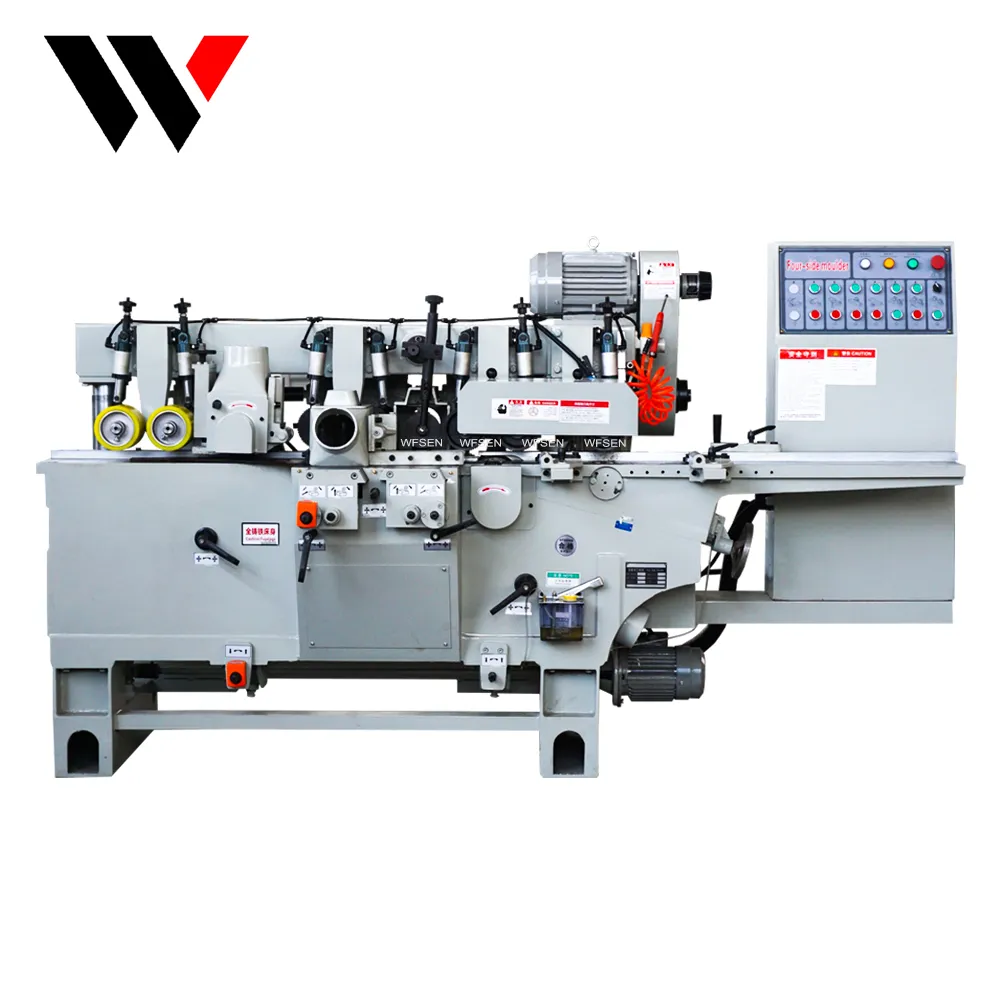
That is three machined faces: bottom, top, right edge. If your section needs the fourth face cut as well, the spindle count changes, and it is worth asking about before you place an order rather than after. A machine sold as a four side moulder does not always carry four cutting heads, and the parameter table is the place to check it.
Four figures on the sheet do most of the filtering.
| Working width | 20 to 150 mm |
| Working thickness | 8 to 100 mm |
| Knife speed | 6000 r/min |
| Max. turn circle | 115 mm |
| Total power | 12.47 kW |
| Weight | 1800 kg |
| Machine size | 2450 x 1650 x 1500 mm |
150 mm of working width sounds generous until you compare it with a cabinet side. It is not a panel machine and it was never meant to be. It is a machine for solid stock: door frames, face frames, skirting, window components, dowel and square stock, table aprons.
The 8 mm lower limit is the one people forget. Below that, thin stock lifts and chatters under the top head, and no amount of feed pressure fixes it. If your work runs thinner than 8 mm, this is the wrong route.
The 115 mm turn circle is the limit on tooling, not on the timber. It caps how far a knife can project from the shaft, which in practice caps how deep a profile you can cut. A 40 mm deep reveal on a window section will not come off this head in one go.
Tip speed, not spindle speed, sets the quality of the cut. A 115 mm circle turning at 6000 r/min travels about 36 metres of cutting edge per second. That is comfortably inside the range where a sharp knife shears softwood and hardwood cleanly instead of scraping them.
The catch is that the speed is fixed. Fit a small 80 mm block and the tip speed falls to roughly 25 m/s, which is where torn grain and burn marks begin to appear on dense timber. On a single-speed head you compensate with feed rate and depth of cut, not with the dial.
Order matters because every head references the one before it. Set the lower head first, exactly as you would set a surface planer: it produces the face that everything else is measured from. Then the upper head for thickness. Then the side head for a square edge, checked with a try square against the finished bottom face, not against the rough top.
Knife projection has to match across the head. A single knife standing 0.2 mm proud will cut alone, take the whole load, and leave a line down the board that no sanding will remove evenly. Set them with a straight edge across the block and check by hand before the feed is engaged.
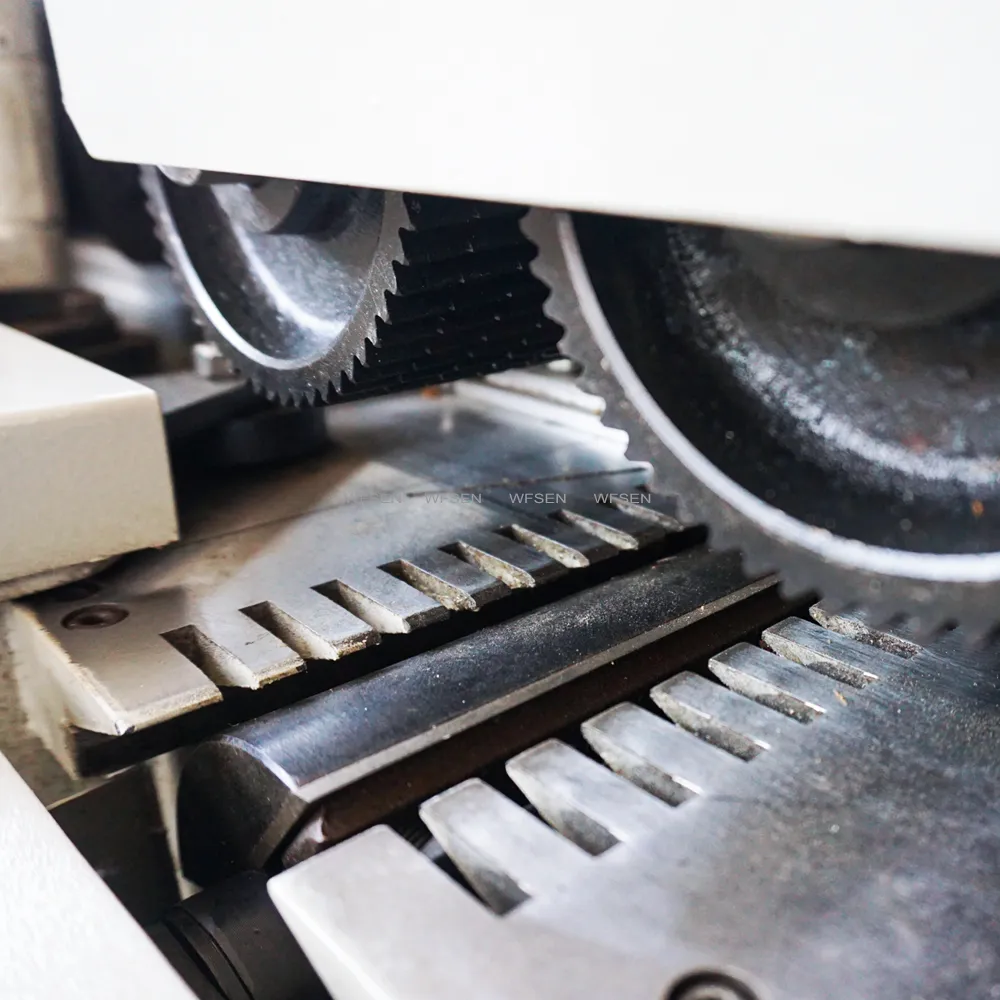
Pressure beam height is the other half of the setup. Too little pressure and the board lifts between heads, so the top face comes out tapered along its length. Too much and the feed stalls on the last metre of a long board, which shows up as a step rather than as a fault.
Three situations argue against a moulder, and all three are about changeover rather than about cutting.
Short runs with a different width each time. Every width change means resetting the side head and the fence, which is the slowest adjustment on the machine. Ten different sections at twenty pieces each is a bad day for a moulder.
Wide work. Anything over 150 mm goes to the B1300 wide thickness planer or through a sander, not through this machine.
Curved and tapered parts. Legs with a taper, shaped rails, anything that is not a constant rectangular section along its full length, belongs on a spindle moulder with a jig.
| Planer, thicknesser, saw | One four side pass | |
| Setups per section | Three, on three machines | One, shared by all sections in a run |
| Operator per section | One per machine, or one walking between them | One at the infeed and outfeed |
| Repeatability at volume | Depends on three operators agreeing | Set once, holds until the knives dull |
| Changing section width | A fence move and a thickness setting | The slowest adjustment on the machine |
| Odd shapes and tapers | Still possible | Not on this machine |
Read the last two rows together and the decision usually makes itself. If the shop runs long batches of constant section, the moulder wins on labour alone. If every job is a different width, the three-machine route stays cheaper because it stays flexible.
Three heads running at 6000 r/min means three sets of knives wearing at the same time, and they do not wear evenly. The lower head takes the rough face and the grit, so it dulls first. The side head, cutting a narrower band, often lasts twice as long.
Shops that run a moulder well do not change all three sets together. They keep a spare set for each head, swap the lower head when the finish starts to tear, and send the set out for grinding while the machine keeps running. That is a maintenance rhythm, not a repair.
A blunt lower head shows up as a fuzzy face that looks almost acceptable in raking light and fails once the board is finished. A blunt side head shows up as a line of torn grain along one arris, which is where the eye goes first on a door frame.
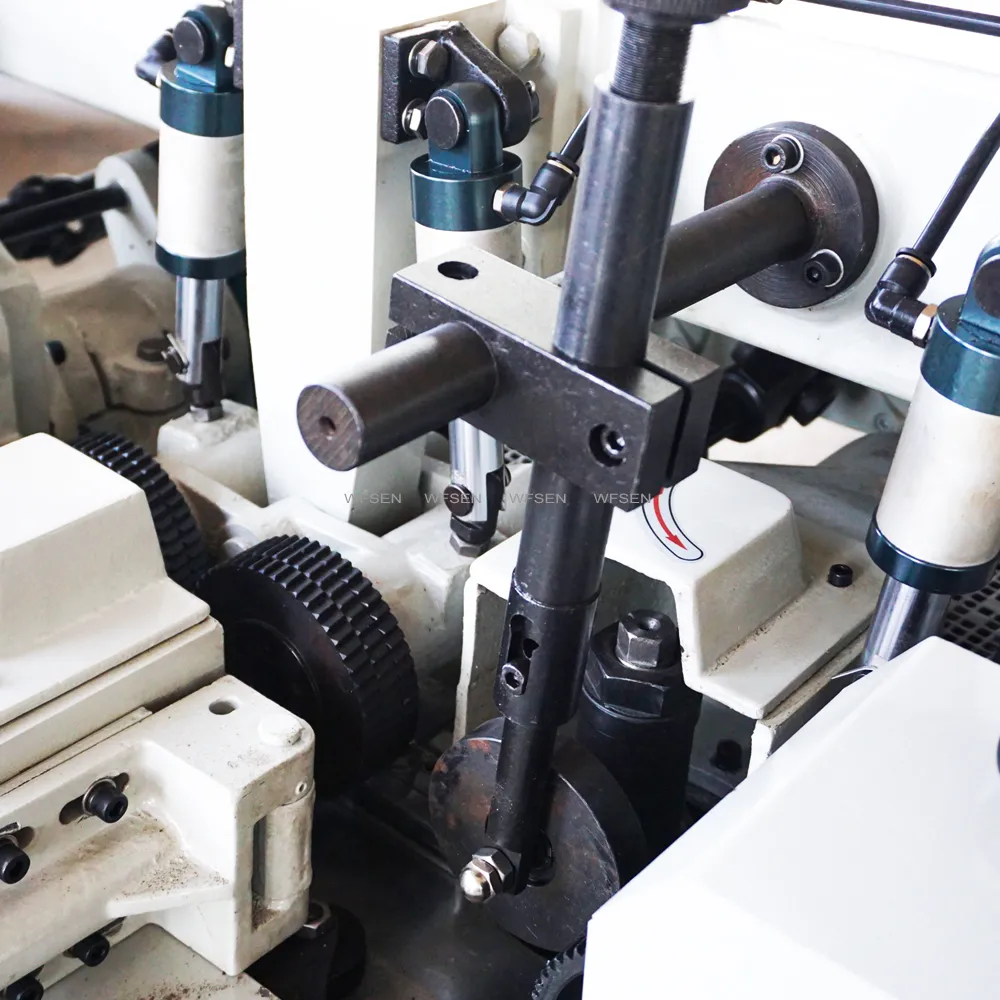
Grinding the knives yourself is realistic if the shop already owns a planer knife sharpener. The sharpening setup we describe here covers straight knives held in a clamp, which is the same knife geometry these heads take.
The machine itself is 2450 mm long and 1650 mm wide, at 1500 mm high. Those are body dimensions, not working dimensions. A board of 2.4 m needs support at both ends, so the real footprint is closer to seven metres of clear floor along the feed line, plus a return path for the finished stack.
Power is 12.47 kW across five motors. That is a three-phase installation, and the starting load of three cutter heads plus a feed motor is worth checking against the shop's supply before delivery rather than after.
At 1800 kg, it also needs a floor that will take it. Most industrial slabs are fine. A mezzanine is not.
Take three boards of the widths you actually buy, one of them twisted, and run them. Look at four things.
Does the twist come out on the lower head alone, or does it need a second pass. Check the finished top face for taper along the length, which means the pressure beam or the top head is out. Check both ends for snipe. Then measure a finished section with a caliper at three points along the board and see how much the thickness moves.
If the shop already owns a MB504 surface planer and an MB104 thicknesser, the moulder does not replace them. It takes over the long runs and leaves the one-offs where they are. The same logic is behind our comparison of thicknesser and surface planer, which covers the two machines a moulder assumes you already understand.
The multi planer range lists the five models side by side, including the MB4015 parameters in full. If your section is wider than 150 mm or your batch is shorter than fifty pieces, say so before ordering, because the answer changes.