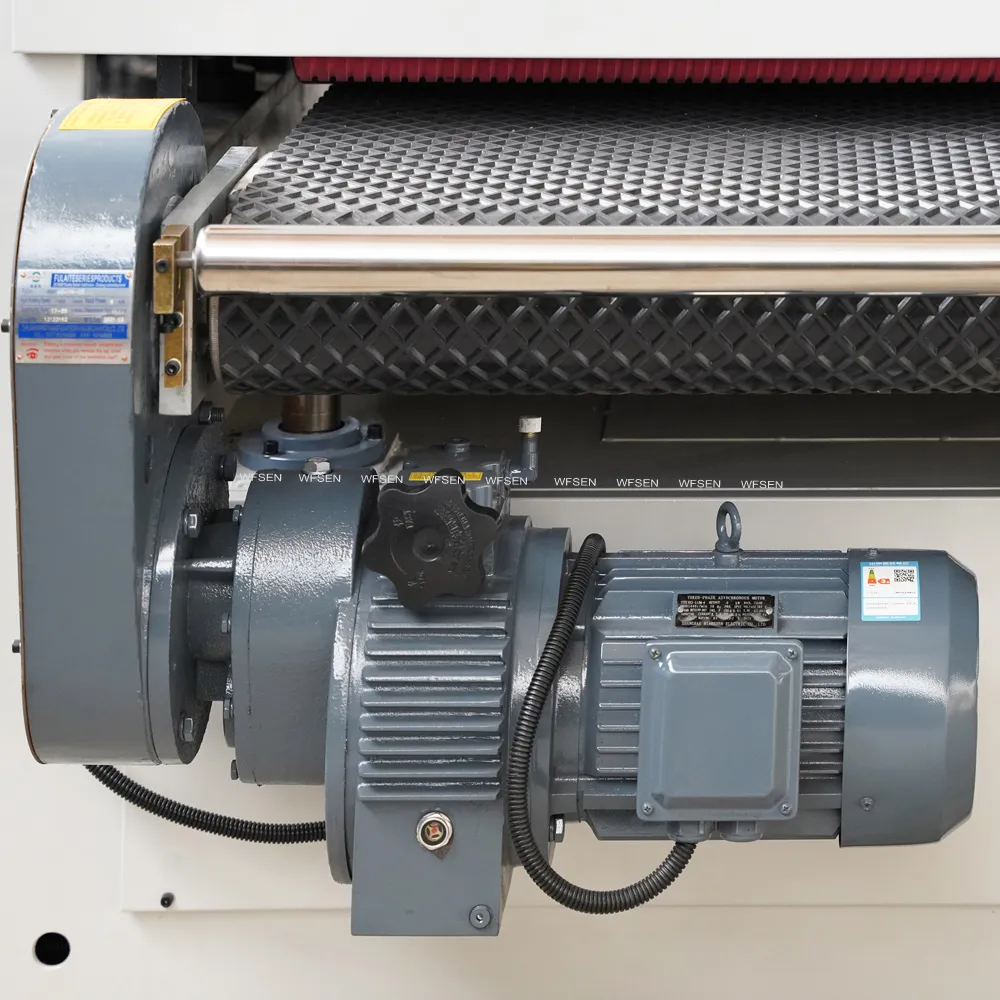
A wide belt sander is usually described by its belt. That is the wrong part to start with. On a contact roller machine the belt is pressed onto the panel by a roller, and the roller decides where the pressure lands, how wide the contact patch is, and whether the belt cuts or polishes. Change the roller and the same belt behaves differently.
On the R-R-RP1300 the three heads carry rollers of 190 mm, 210 mm and 240 mm depending on the build, with abrasive belts of 1020 x 2020 mm on the 1000 mm machine and 1320 x 2020 mm on the 1300 mm machine. Those four numbers — three roller diameters and one belt size — explain most of what the machine can and cannot do.
Contact rollers and belt on a three head sander. Filmed in the assembly bay.
A small roller wraps the belt around a tighter arc, so the belt meets the panel over a shorter length but at a sharper angle. A large roller spreads the same pressure over a longer patch and the belt leaves the panel more gradually.
There is a second effect that matters more in practice. A large roller gives the belt more wrap, so more of the abrasive is in contact at any moment and the heat is spread over a longer arc. That is why a finishing head can run a finer grit at the same feed speed without burning, while the same grit on a small roller will glaze the surface.
That difference is why the first head and the last head are not built the same. The first head has the most material to remove and wants a firm, narrow contact so it cuts. The finishing head wants a wider, gentler contact so it blends. On this machine the first head runs 37 kW on the wide build, and the second and third run 22 kW each. The motor sizes follow the work, not the other way round.
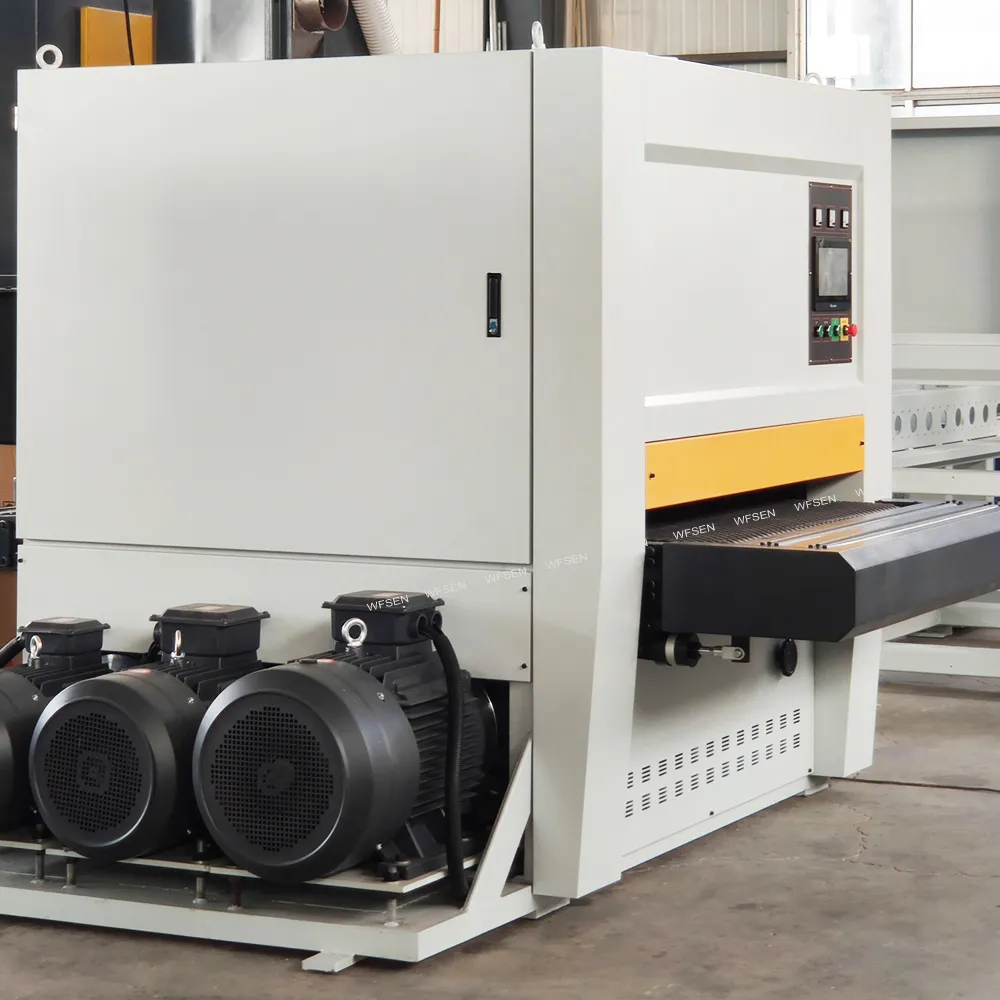
A hard roller keeps its shape under load, so the contact patch stays predictable and the cut is even across the panel width. A softer roller deforms, wraps the belt around edges and profiles a little, and forgives a panel that is slightly out of flat.
The trade is straightforward. Hard rollers give you a flatter face and a more visible scratch pattern if the grit is wrong. Soft rollers hide small errors and make it harder to hold a tolerance. Shops that sand veneered panels tend to want the softer end, because a hard roller on a thin face will cut through before the operator notices.
The belt has to be tight enough not to slip under load and loose enough not to stretch or cup. Tracking is what keeps it on the roller, and on this machine tracking and oscillation run on 0.6 MPa of working air. That figure matters more than it looks: a sander with a weak air supply will oscillate slowly or not at all, and a belt that does not oscillate loads in one stripe.
This is the reason a machine of this size wants its own compressor rather than a shared line. If the shop air already feeds a spray booth and a few cylinders, the sander gets whatever is left at the end of the day. The compressor note covers how to size that supply against a stated pressure.
The point of a three head machine is not three times the speed. It is that the panel does not get handled three times. Working thickness runs 3 to 110 mm and feed speed 6 to 30 m/min, so a 30 mm panel at the top of the feed range passes all three heads in a single pass.
Handling is where the damage happens: a panel lifted off a bench and stacked on a trolley picks up grit, and grit under a belt leaves a scratch that no fourth pass will remove. Every time the panel leaves the machine, someone has to re-datum it.
Belt size decides surface temperature.
A 1320 x 2020 mm belt carries more abrasive and more backing than a 1020 x 2020 mm belt, so it runs cooler at the same load and holds grit longer. That is a belt-life argument, not a quality argument, but it turns into quality when a tired belt starts burnishing instead of cutting.
It also decides your spares shelf. Two belt sizes means two part numbers and two minimum stocks. A shop running one width should buy one width.
Stored belts are their own problem. A belt left hanging on a nail takes a set and tracks badly for the rest of its life, and a belt kept in a cold room becomes brittle at the joint. Coiled in its box, on a shelf, out of the sun — that is the whole storage specification, and it is the one most shops skip. Two belts bought together can behave differently a year later purely because of where they were kept.
The useful check during setup is not the finished panel. It is the panel between the first and second head, and again between the second and third. If the first head has not taken the planer marks off completely, the second head will spend its life polishing a ridge instead of calibrating.
If the panel is twisted coming in, no sander will fix it. That fault is upstream, and the wide thickness planer is where it starts.
The three heads are not set to the same height. The first sits a little lower than the finished thickness, the second and third come progressively closer to it. What the operator sets is the relationship between them, not three independent numbers.
Get that relationship wrong and the machine still runs, still sounds normal, and still produces a panel that looks acceptable in the stack. The error shows up two steps later, at the edge bander, when the banded edge sits proud on one face and flush on the other. By then the panel has been cut and the material is committed.
This is the argument for setting the machine on a sample of the actual board rather than on a scrap of the same thickness. Glue line, veneer and core all move the number.
The grit sequence is also a machine decision.
On a single head machine the operator changes belts between passes, and each change costs a re-feed of every panel. On three heads the sequence is loaded once: coarse on the first, medium on the second, fine on the third.
The practical consequence is that a three head machine lets you use a proper sequence without paying for it in handling. A shop that skips a step to save a belt usually ends up sanding the same panel twice at the finishing head, which costs more than the belt it saved.
It also means belt inventory is planned per head, not per machine. Three grits, three positions, and a rule about which one runs out first.
The specification lists the dust collector at 5.5 kW on the narrow build and 7.5 kW on the wide one. A 1300 mm cut produces a continuous chip ribbon, and a ribbon needs volume rather than suction. A bag unit sized for a planer will not hold it.
The pulse and bag comparison sets out where each type stops working.
A recipe on this machine holds head height, feed speed, belt tension and oscillation together. That is the whole setting, not a shortcut. The value is in the second run of a repeat job: the operator loads the recipe and checks, instead of adjusting four things and hoping.
It also makes a change auditable. If a batch comes out different from the last one, the recipe is the first thing to read, before anyone blames the belt.
The wide build is 2180 to 2550 mm long, 2600 mm wide and 1950 mm high, at 3200 to 4100 kg. The narrow build is 1880 to 2180 mm long at 2000 to 2900 kg. At that weight the machine wants a floor it can sit on without shimming, and it wants the door wide enough on the day it arrives.
Four questions settle most of it. What is the widest panel you glue? What thickness range do you actually run? How many heads does the finish require? And what air supply can you give the machine on its own?
A narrower machine that runs every day beats a wide one that runs twice a week, and a two head build on the same frame is often enough for a shop that only sands one face. The sander types compared covers where the families divide. If the next step after sanding is a polished face, the polishing machine takes that job.
There is a fifth question that decides more than any of the four: who sets the machine. A three head sander with a stored recipe can be handed to an operator who has never run one, because the setting is a number rather than a feel. A two head machine without one depends on whoever is standing there at seven in the morning. That difference costs nothing on the invoice and shows up every week in the scrap bin.
Send board type, panel size and the thickness range. We confirm the build, the belt size and the roller count in writing, and say when a narrower machine would do.
Where the machine stops being the problem.
Most sander complaints that reach the workshop are not sander faults. A panel that arrives twisted, a belt stored in a damp corner, a compressor that drops to 0.4 MPa in the afternoon — each of those produces a surface defect that looks exactly like a machine problem.
The way to separate them is to change one thing at a time and keep the recipe fixed. If the defect moves when you change the belt, it is the belt. If it stays in the same place on the panel regardless of belt and head, look upstream at the press or the planer. If it appears only after lunch, look at the air.
That order costs an hour and saves a service call. It also tells you something about the machine you bought: a sander that responds predictably to a belt change is a sander whose heads were set properly in the first place.
More on sanding machines or the factory.