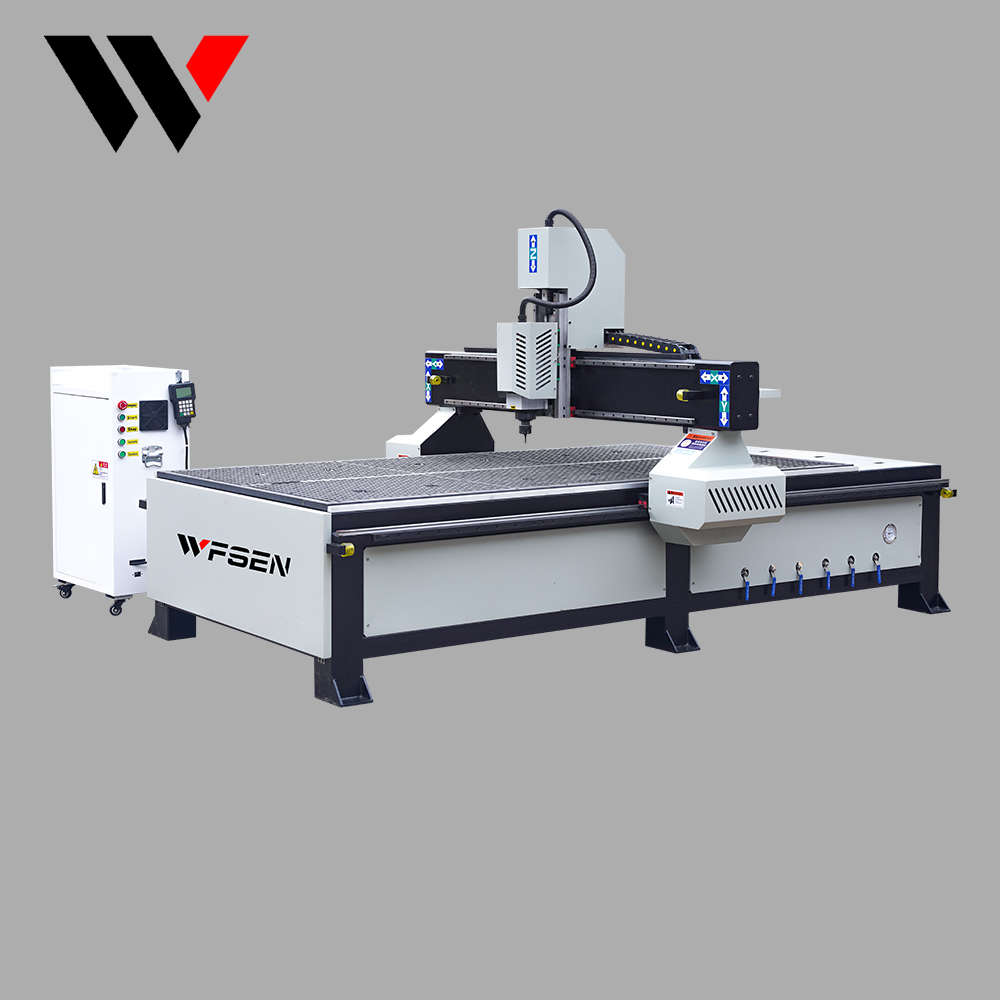
A nesting table is not bought for its spindle. It is bought for what leaves the table: every part cut to size, an offcut still worth putting back on the rack, and a sheet rate you can plan a shift around. Those three things are decided long before the spindle starts.
This page is about that job, not about comparing spindles. Three of the four machines on this site share one table size, so the interesting differences sit in software, hold-down and tooling rather than in the catalogue numbers.
The KS1325A runs one 9 kW spindle with 12 knives on a 1300 x 2500 mm table. The KF1325A runs four 6 kW spindles on the same table. The KC1325A runs a single 6 kW spindle, also on 1300 x 2500 mm. The FS1631A steps up to 1600 x 3100 mm and carries saw blades as well as spindles.
Three machines, one table, three different production ideas. That is the useful way to read the range: not as three grades of the same machine, but as three answers to how many operations a sheet needs before it comes off the bed.
A standard sheet is 1220 x 2440 mm. The table is 1300 x 2500 mm, which leaves 80 mm across and 60 mm along. That is not spare capacity. It is where the clamps, the tool entry and the path clearance live.
Nest too close to the edge and the cutter leaves the sheet while the vacuum is still holding it, or the clamp sits where a part should be. The slack exists so the first cut can start inside the board and the last one can finish without the tool running off into the frame.
Working height is listed as 200 mm on the KF1325A and KC1325A. That is the Z travel, and it has to cover the board, the sacrificial bed beneath it and the tool stick-out. A taller stack is a different machine class rather than a deeper setting, so a shop that intends to cut stacked sheets should say so before the quotation rather than after.
Two shops with identical machines can differ by several sheets a day, and the difference is the nesting file. Grain direction, part rotation, where the offcut is parked, how much gap sits between parts: four decisions made in software, none of them in the specification table.
Grain is the one buyers forget. A door rail rotated to fill a gap looks efficient on screen and fails in the room, because the grain now runs across the part instead of along it. Good nesting locks grain first and packs second.
Offcut handling is the second. A nest that fills the sheet edge to edge leaves a sliver nobody can use. A nest that reserves a straight strip leaves something that goes back on the rack for a later job, and that strip is often worth more than the parts cut from it.
None of this appears in a quotation. It appears at the end of the month, in how many sheets went in and how many parts came out, which is why the person who runs the nesting file is worth as much to the shop as the table on the floor.
All four machines list six vacuum areas. The vacuum motors are 7.5 kW on the three 1325s and 11 kW on the FS1631A. Six zones is what lets you close off the part of the table you are not using, so the pump is not pulling air through an open area.
The problem arrives late in the cut. While the sheet is whole, air cannot get under it. Once the surrounding material has been cut away, a small part has far less area holding it down, and the last few hundred millimetres of cut is where it moves. That is why sequence matters: cut the small parts while the sheet is still connected, and leave the large ones for the end.
The common workarounds are a skin left at the bottom of the cut, or small tabs that get trimmed afterwards. Both cost a second pass. A shop that nests many small parts should plan for that pass in the sheet rate rather than discover it in week one. The zone layout itself is covered in the 1325 table and spindle guide.
Zones are also where the larger machine earns its motor. The FS1631A lists 11 kW of vacuum against 7.5 kW on the three 1325 machines, on a table half again as large. The same six zones on more area need more pull to hold the same board.

The KS1325A carries one 9 kW spindle and lists 12 knives. One spindle means one tool at a time, so a sheet that needs a 6 mm cutter for the outline and an 8 mm for the holes stops between operations.
The KF1325A carries four 6 kW spindles and lists a changeover of 0 second. Four spindles means four tools already resident, so the machine moves from one operation to the next without an operator touching it. Total spindle power is higher than the single-spindle machine, 24 kW against 9 kW, but each individual spindle is smaller.
Read the 0 second figure as a description of the mechanism rather than a claim about the cycle. Nothing changes tools in no time. What it tells you is that the change is handled by the machine, and the number to ask about is how many tools can stay resident for the work you actually run.
The FS1631A is the one machine in the range that combines both, listing saw blades alongside its spindles, on a 1600 x 3100 mm table with an 11 kW vacuum motor. Blade for the straight runs, bit for the curves and holes.
That split is worth understanding even if you never buy the machine. A saw blade cuts a straight line fast and leaves an edge that a router bit has to work harder to match. A bit can follow any path but spends its time in the cut. Shops that cut mostly rectangles get most of the benefit from the blade, and shops that cut curves get almost none.
One line on that sheet needs confirming before an order: it lists two spindles and four spindle motors at 5.5 kW. Those two figures do not agree with each other, and a mixed machine is exactly where a quotation should carry the exact configuration in writing rather than a model code.
Working speed is listed as 20000 mm/min on the two 1325 machines and 18000 mm/min on the KC1325A and FS1631A. Twenty thousand millimetres a minute is twenty metres a minute of toolpath. It is not sheets per hour, and the gap between the two numbers is where production planning usually goes wrong.
Take a sheet of cabinet parts with 40 metres of toolpath, as an example. At 20 m/min that is two minutes of cutting. Then add the tool change, the transfer of the next sheet, the tabs, and the unloading. The two minutes are real; they are just not the sheet rate.
Which is why the useful question at quotation time is not the feed figure. It is how long a complete cycle takes on a sheet the buyer actually cuts, with the tool changes and the loading included. Any supplier who can answer that has done the arithmetic; one who quotes millimetres per minute has not.
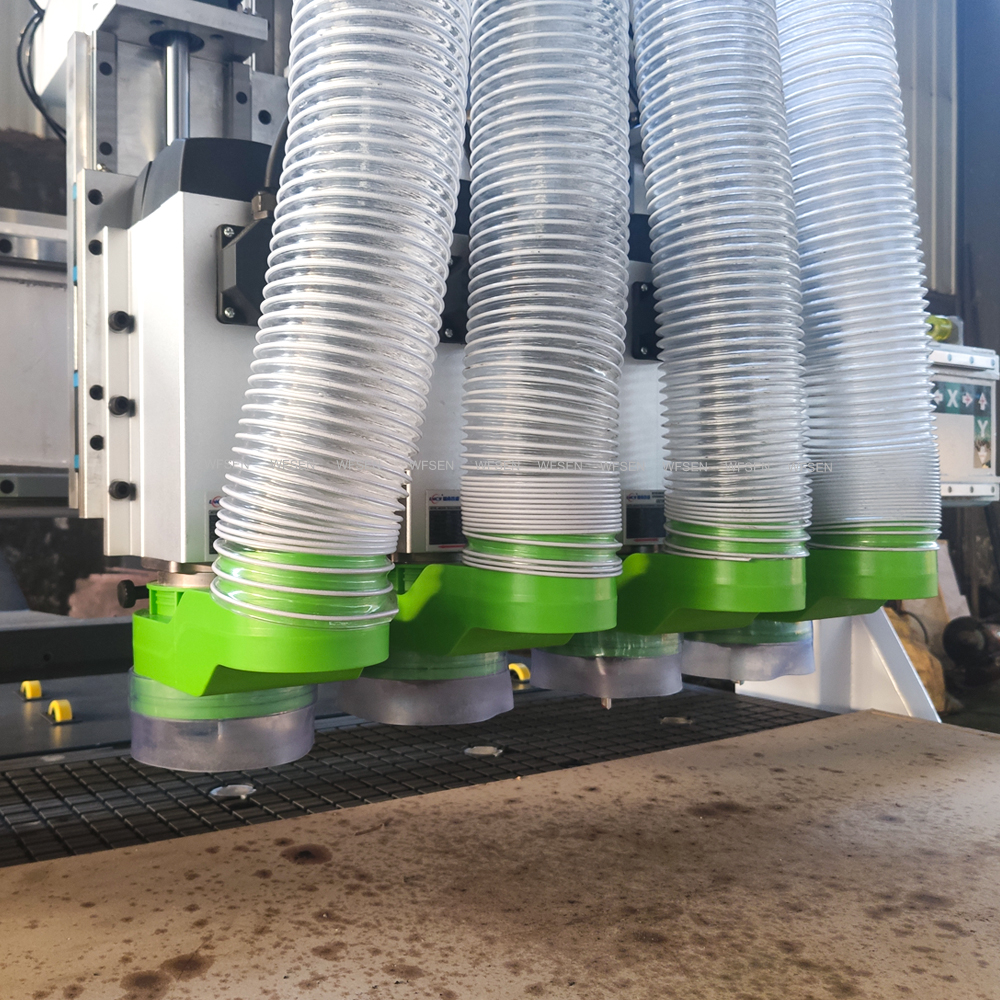
All four machines list a position precision of plus or minus 0.02 mm. That figure describes how accurately the head arrives at a coordinate. It is not the tolerance of the finished part, and reading it as one is the most common mistake in this category.
Part size error comes from three other places: the cutter diameter and its wear, how well the sheet was held while the last cut ran, and how flat the bed still is after a few hundred sheets. A machine that repeats to 0.02 mm on a moving part still produces panels that differ by a fraction of a millimetre if the bed has been skimmed unevenly.
What actually matters at assembly is not one part in isolation. It is the pair: the dowel holes against the panel edge, and the edge against the next panel. Those two numbers decide whether the cabinet goes together square, and both are set by the nest and the tool, not by the positioning figure.
One check worth running on any machine, new or used: measure the first part off a sheet and the last part off the same sheet. If the two differ, the bed or the hold-down moved during the cut, and no positioning figure in a catalogue will explain it.
These two get quoted against each other constantly, and they do different jobs. A CNC beam saw takes a stack of sheets and cuts rectangles, fast, with a square edge and no nesting at all. Nesting takes one sheet at a time and cuts shapes, holes and curves from it.
If every part is a rectangle in a stack of twenty, the beam saw wins on rate and edge quality. If the parts have curves, cut-outs or drilling that would otherwise need a second machine, nesting wins because it does all of it in one setup. Most cabinet shops end up with both, and the split sits at how much of the work is straight.
The comparison between beam saw and vertical panel saw covers the straight-line side of that decision. The MJ2800 is the specific model to read if the straight-line volume is the larger half.
The widest sheet that actually reaches the shop. Not the standard size, the real one, because an oversized board decides between a 1325 table and the 1600 x 3100 mm one on its own.
The thickest board and the stack height, including whatever goes under it. Together they tell you whether 200 mm of travel is comfortable or marginal.
The smallest part on a normal sheet. It is the number that decides how much of the job will need tabs or a skin, and therefore how much of the cycle is spent on a second pass.
The operations per sheet, counted honestly. Outline, holes, grooves, hinge cups: each one is either a resident tool or a changeover, and that count is what separates one spindle from four.
Then the floor. The 1325 machines measure 3500 x 2400 x 2000 mm overall; the FS1631A measures 4600 x 2600 x 2000 mm. Loading a sheet needs clear space on at least two sides, and that space is usually the thing a workshop does not have when the machine arrives.
All four machines are collected under CNC router. If the panels leaving the table need surface finishing before assembly, the sanding machine range is the next stop in the line.