A beam saw pushes a panel under a travelling blade. A reciprocating saw brings the blade to the panel, on a horizontal stroke, and cuts a stack of light material that would collapse or tear on a panel saw. The two machines share a work envelope and nothing else.
The MJR1325 is built around that second idea. Its stroke travels across a 1300 mm width and a 2500 mm length, at a published thickness limit of 40 mm, driven by a 2.2 kW motor at 10 to 15 strokes a minute. Cutting precision is listed at plus or minus 0.2 mm.
Twenty-five hundred millimetres of length is not an accident. It is the length of a standard board and a little over the width of a 1220 by 2440 sheet, which tells you what the machine expects to see: full-size light panels, not cut-down parts.
The product page names the intended materials directly: aluminium honeycomb, MDF and WPC board. That list is short and it is honest, and each entry explains a different part of the design.
Aluminium honeycomb is the reason the machine exists in this form. A 20 mm honeycomb core has almost no resistance to a blade pushing into it edge-on, and a conventional panel saw either crushes the cell walls or lifts the skin away from the core as the tooth exits. A reciprocating stroke cuts on the pull and the push with the panel held flat and still, so the skin stays bonded and the cut edge closes cleanly.
MDF behaves the other way. It is homogeneous and abrasive, it dulls a blade quickly, and 40 mm of it in one pass loads a 2.2 kW motor steadily rather than in spikes. The blade that comes with the machine is a 355 mm disc, 25.4 mm bore, 3.2 mm kerf, 120 teeth, which is a fine-tooth configuration intended for a smooth edge rather than for fast ripping.
WPC board sits between the two. It machines like a dense plastic-wood composite, it can smear if the blade runs hot, and it rewards a slower stroke. Ten to fifteen strokes a minute is slower than most people expect, and it is the figure that tells you this machine trades speed for edge quality on purpose.
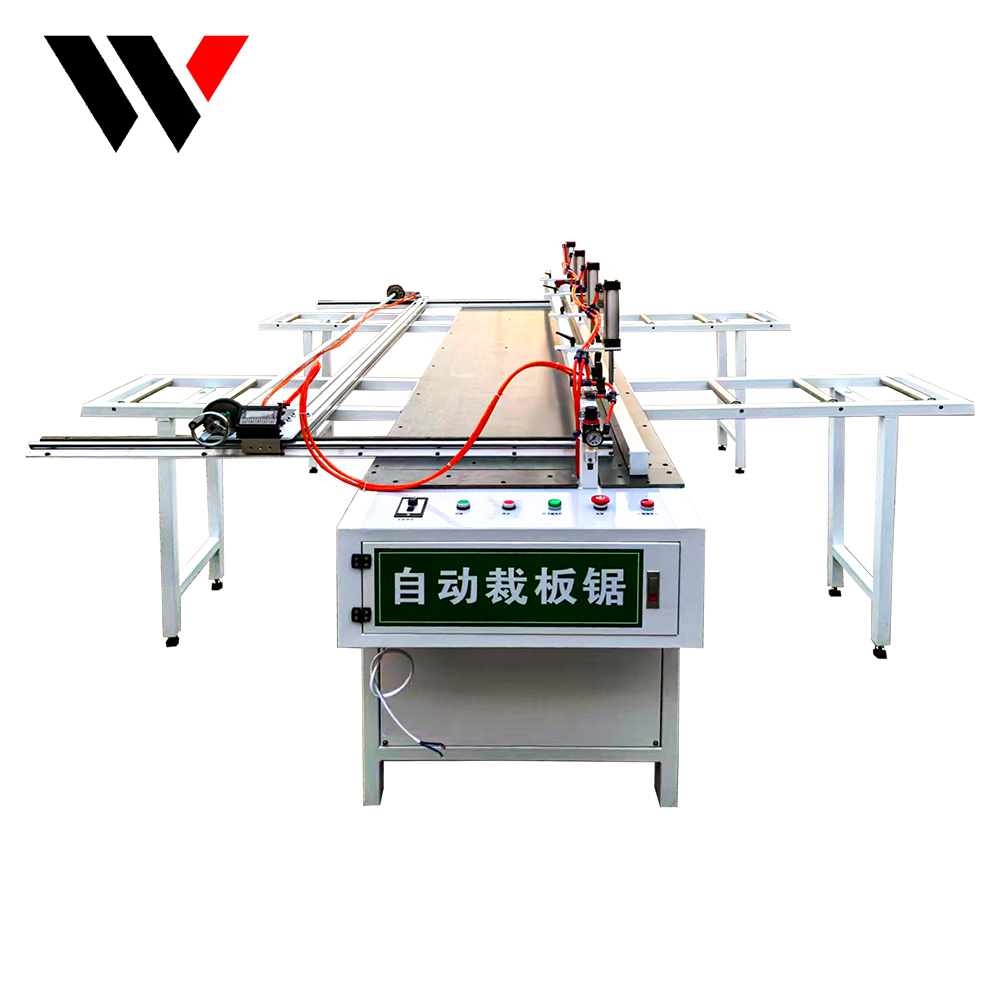
Plus or minus 0.2 mm is a tolerance on the finished part, and where it comes from matters more than the number. On a reciprocating saw, accuracy depends on three things: how squarely the panel sits against the fence, how rigidly the carriage tracks, and how much the blade deflects in the cut.
The first is the operator's job and it is the one that fails most often. A honeycomb panel is light, it looks flat when it is not, and a 1 mm bow across 2500 mm will close the tolerance on its own before the blade touches the material.
The second is the machine. A 500 kg frame carrying a carriage across 2500 mm has to hold its line; that is what the weight is for. The footprint is 3200 by 2800 mm, so the frame is wider than the work, which is the geometry that keeps the carriage from rocking at the ends of the stroke.
The third is consumable and predictable. A 120-tooth blade in MDF will deflect less than in aluminium honeycomb because the load per tooth is lower. If your parts hold 0.2 mm in MDF and drift in honeycomb, the blade is the first thing to change, not the machine.
Forty millimetres of maximum working thickness is not a conservative figure chosen to protect the motor. It is where the stiffness of a 355 mm blade stops being enough on a horizontal stroke.
Blade deflection rises with the cube of the unsupported span. A thicker cut means a longer engagement and a longer span, and past a certain depth the blade starts to lead the cut, which shows up as a taper in the part rather than as a stalled motor. The motor has margin; the blade does not.
This is why the machine is not sold for solid timber. Someone will ask whether it can cut a 60 mm oak benchtop. It cannot, and the reason is the blade, not the 2.2 kW. If your work is solid stock at that thickness, the route is a beam saw or a band saw, not a longer stroke.

There is no scoring unit, no riving knife, no variable geometry. What you get is one blade specification, and the whole quality of the cut follows from it.
A 120-tooth blade at 355 mm has a fine pitch. Fine pitch means a small chip load per tooth, which is what keeps a honeycomb skin from being pushed away from its core and what keeps MDF edges from chipping. It also means the gullets are small, so the blade clears chips slowly and heat builds up in the cut rather than in the swarf.
Two practical consequences. First, run the stroke rate at the low end on thick MDF and let the blade clear; running 15 strokes a minute in 40 mm MDF is how edges burn. Second, keep a second blade on the shelf. A blade that has cut aluminium honeycomb has been through abrasive material, and the same blade used afterwards on MDF will cut undersize long before it looks dull.
Blade changing is not a precision operation on this machine, which is deliberate. The blade is a consumable and the design treats it that way.
The 2500 mm length makes the machine a sheet machine. It is not a parts machine, and shops that buy it for parts usually regret it.
Cutting a 400 mm wide strip from a 2440 mm sheet is a two-minute job. Cutting thirty 400 by 600 mm rectangles out of the same sheet is a slow, repetitive day, because every part needs a new fence position and a new clamp, and the stroke does not care how big the part is. A beam saw nests; a reciprocating saw does not.
Where the machine earns its place is the first breakdown: full sheets into oversize blanks for a CNC router, honeycomb panels into door blanks, WPC into cladding lengths. That is one or two cuts per sheet and a fast turnaround, and it is exactly what a 10 to 15 stroke rate is good at.
If your volume is nested parts from composite panels, the machine you want is a CNC beam saw, and the comparison between saw types is set out in our panel cutting machine guide.
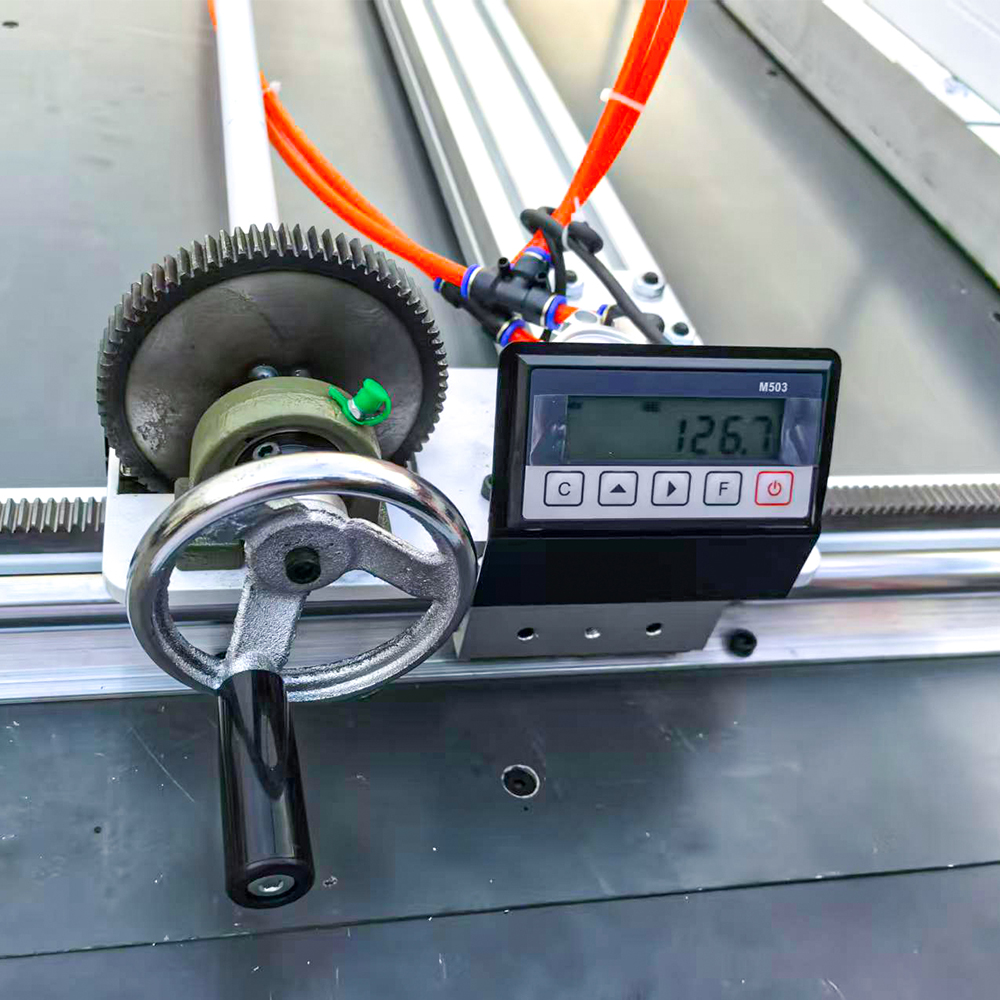
At 3200 by 2800 mm the machine occupies a rectangle that will not fit through a standard workshop aisle, and it needs clear floor on both sides because a 2500 mm panel has to be loaded and unloaded somewhere. Budget roughly twice the machine footprint in clear space.
Five hundred kilograms does not need a special slab. It does need to sit level, because a frame that is out of level will produce a part that is out of square at the ends of the stroke and correct in the middle, which is a confusing fault to chase.
Power is single-motor, 2.2 kW. That is a modest load and most workshops can supply it without a change to the distribution board. The machine does not need compressed air, which matters if it is going into a light-composite shop that has no compressor.
A reciprocating stroke produces dust along the whole cut line, not a concentrated stream. Extraction has to be connected close to the blade and it has to move enough air to catch the fines that a 120-tooth blade generates, because those fines are the fraction that hangs in the air.
The cutting table on a machine this size collects a lot of debris underneath. Plan for a bin or a floor-level extraction point beneath the bed, not just a hose at the head.
Edge finish is where the machine is judged. A good cut in MDF leaves an edge that needs light sanding, not a re-cut. If the edge is fuzzy along one half of the stroke and clean along the other, the panel is not flat against the fence, and no blade change will fix it.
The machine sits at the front of the process, before edge banding, before drilling, before assembly. For a shop working with composite panels, the order is: break down the sheet, cut the part, edge it, drill it.
For honeycomb door blanks the order changes, because the blank goes to a press before it goes anywhere else. Our hot press range and the hot press cycle guide cover that stage, and the cold press range covers the low-temperature alternative when the core cannot take heat.
Take three panels of the material you actually cut, including one that has been in the rack long enough to bow, and run them. Then check four things.
Square the finished part corner to corner. If the diagonals differ by more than twice the published tolerance, the fence is out or the panel moved.
Look at the entry and exit edges separately. A clean entry with a torn exit means the blade is exiting into unsupported material, and the support, not the blade, needs attention.
Measure the kerf at both ends of a 2500 mm cut. A kerf that widens towards the far end is carriage play.
And run the stroke at both 10 and 15 a minute in the same material. If the faster setting gives you an acceptable edge in your product, the machine will pay for itself sooner, because the cycle time difference over a shift is larger than the difference in purchase price.
This machine cuts light composite panels up to 40 mm thick, up to 1300 mm wide and 2500 mm long, at 10 to 15 strokes a minute, to plus or minus 0.2 mm. It does not cut solid hardwood, it does not nest parts efficiently, and it will not replace a beam saw in a panel furniture plant.
What it does is break down honeycomb, MDF and WPC sheets without crushing the core or lifting the skin, in one pass, on a footprint that fits a workshop making doors, cladding or composite furniture. That is a narrow job description, and the machine is built exactly for it.
Full figures are on the MJR1325 reciprocating saw page. The wider range, including the vertical panel saws and the beam saws, sits under saw machines, and the panel cutting comparison puts all six models side by side.
If your material is a composite we have not listed, send a sample. Cutting a sample answers more than any specification sheet.